


Plugixa Exam
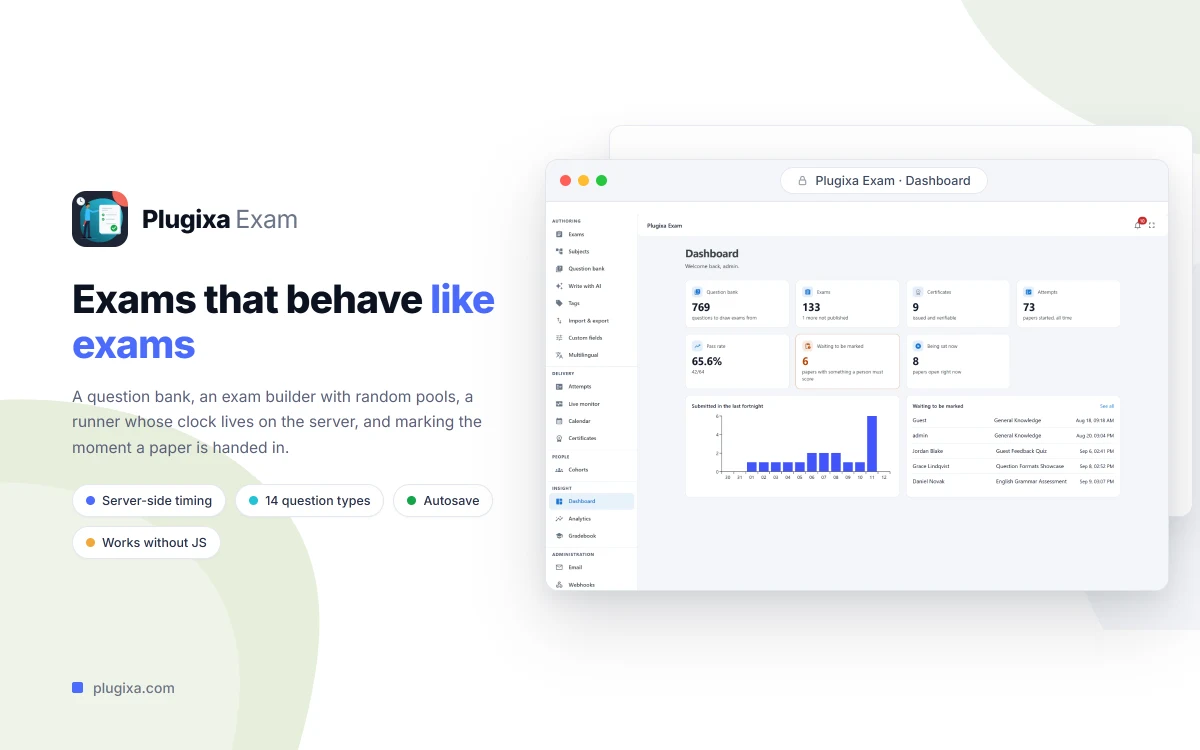
Most WordPress quiz plugins were built to gate a course, not to run an assessment: the timer lives in the browser where it can be edited, the paper is read live so fixing a typo changes the exam under whoever is sitting it, and switching JavaScript off stops the whole thing. Plugixa Exam is built the other way round - the deadline is computed and stored on the server when the attempt starts, the question set is frozen into the attempt at the moment it begins, and the runner degrades to an ordinary form post.
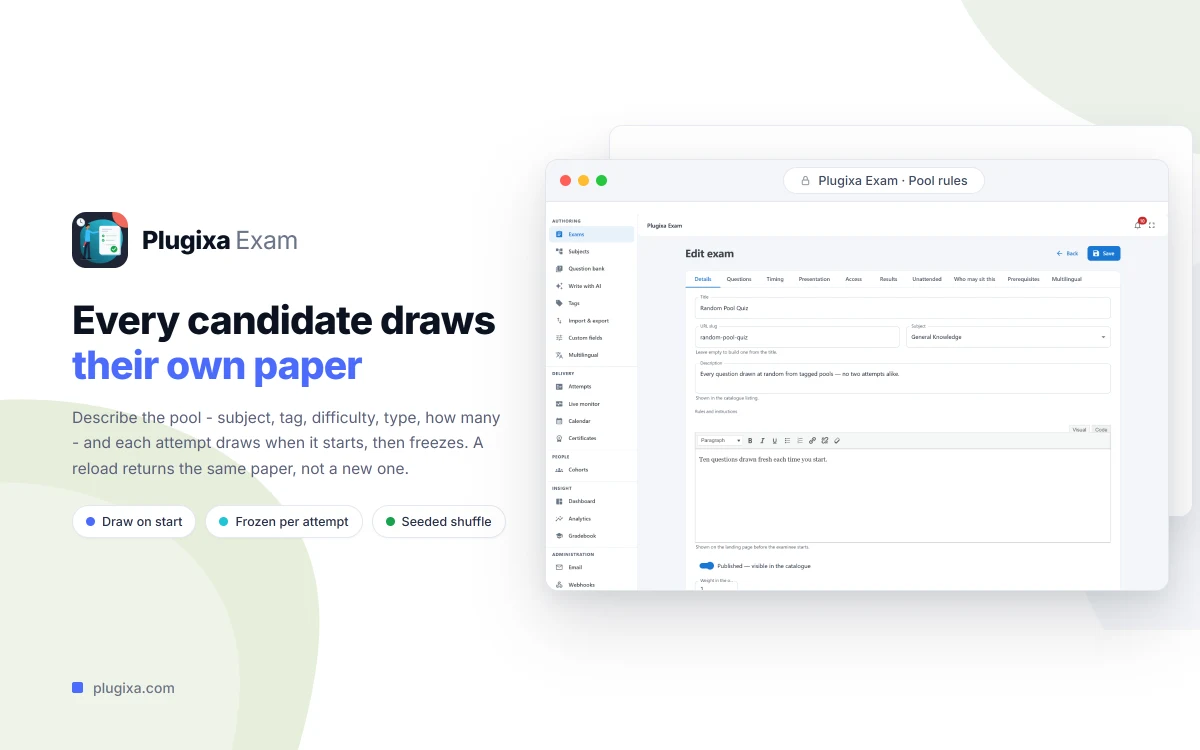
Write questions once into a bank organised by a subject tree and by tags, then build exams out of it. A section is either a fixed list of questions or a pool with rules - subject, tag, difficulty, type, how many to draw - so every candidate can draw their own paper. Seven question types ship free and fourteen with Pro, all contributed through a single filter, which is why a downgrade never breaks a question you have already written.
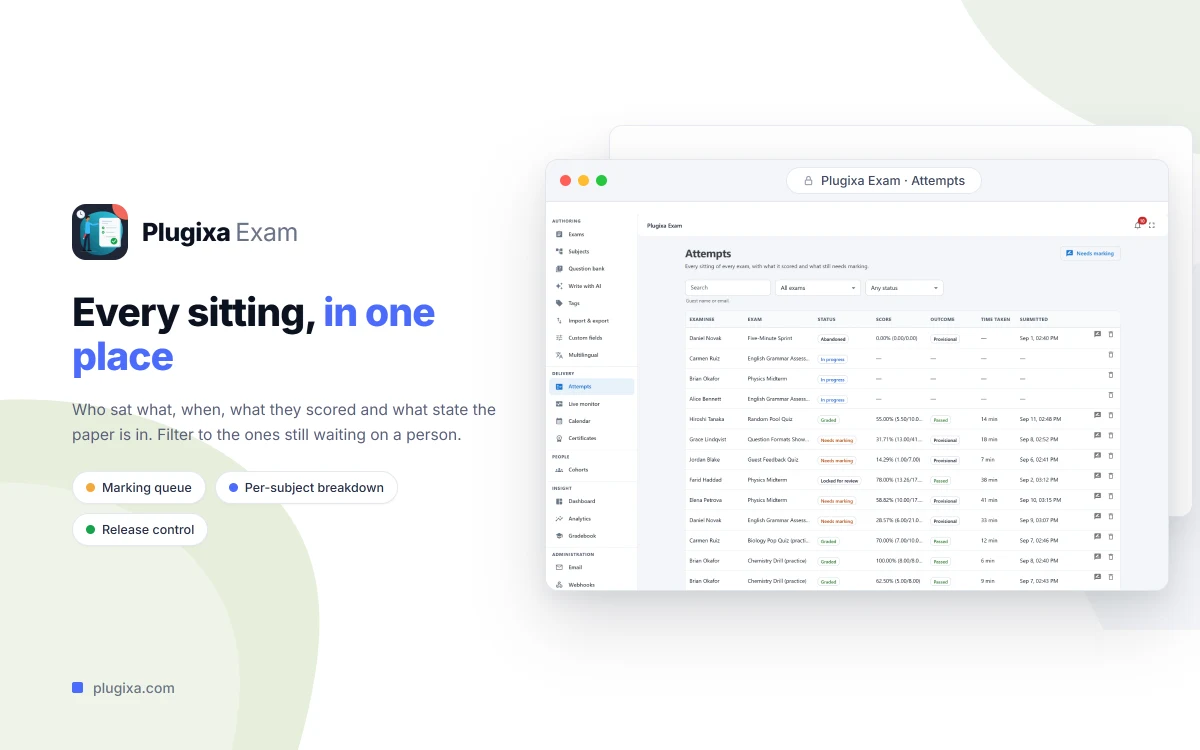
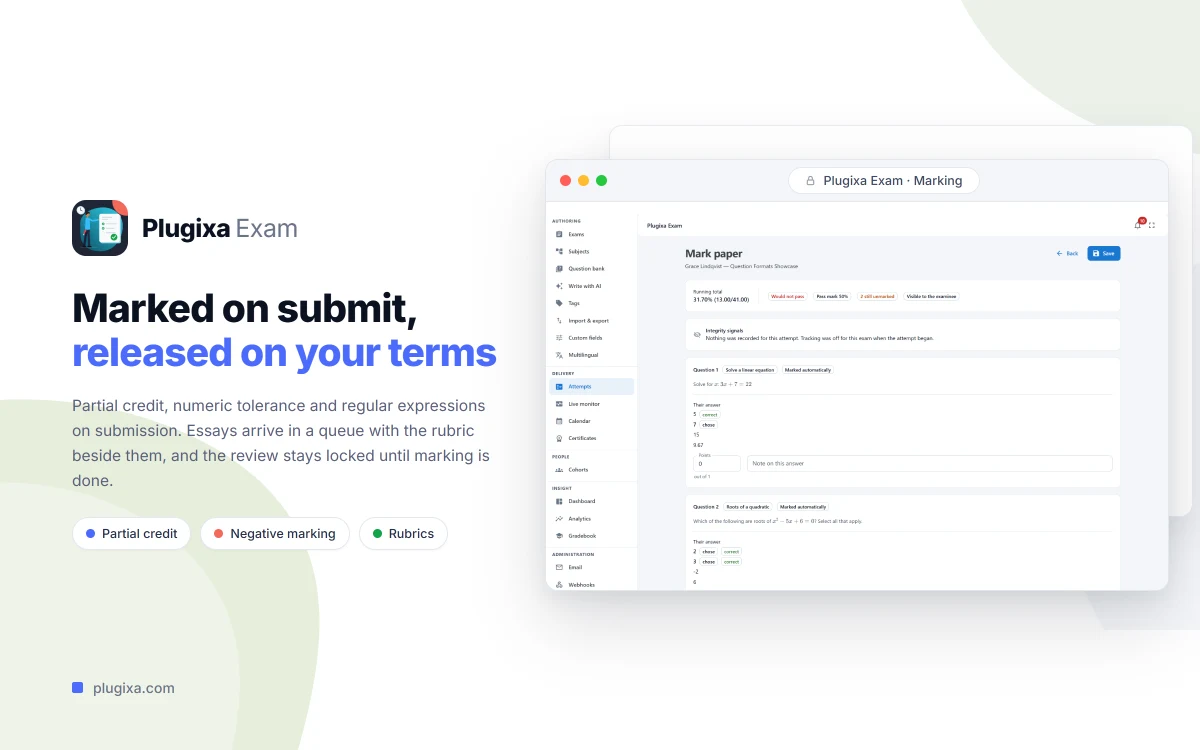
Everything that can be marked automatically is marked on submission, with partial credit, numeric tolerance and regular expression matching; essays queue for a person with the rubric beside them. Results are released immediately, when the exam closes, on a date you choose, or only when you say so. An exam can be open to everybody, restricted by role, opened with an access code, or sat by a named guest - and attempt caps and cooldowns are enforced on the server, not in the page.



Screenshots
See it in action
Features
Everything you need
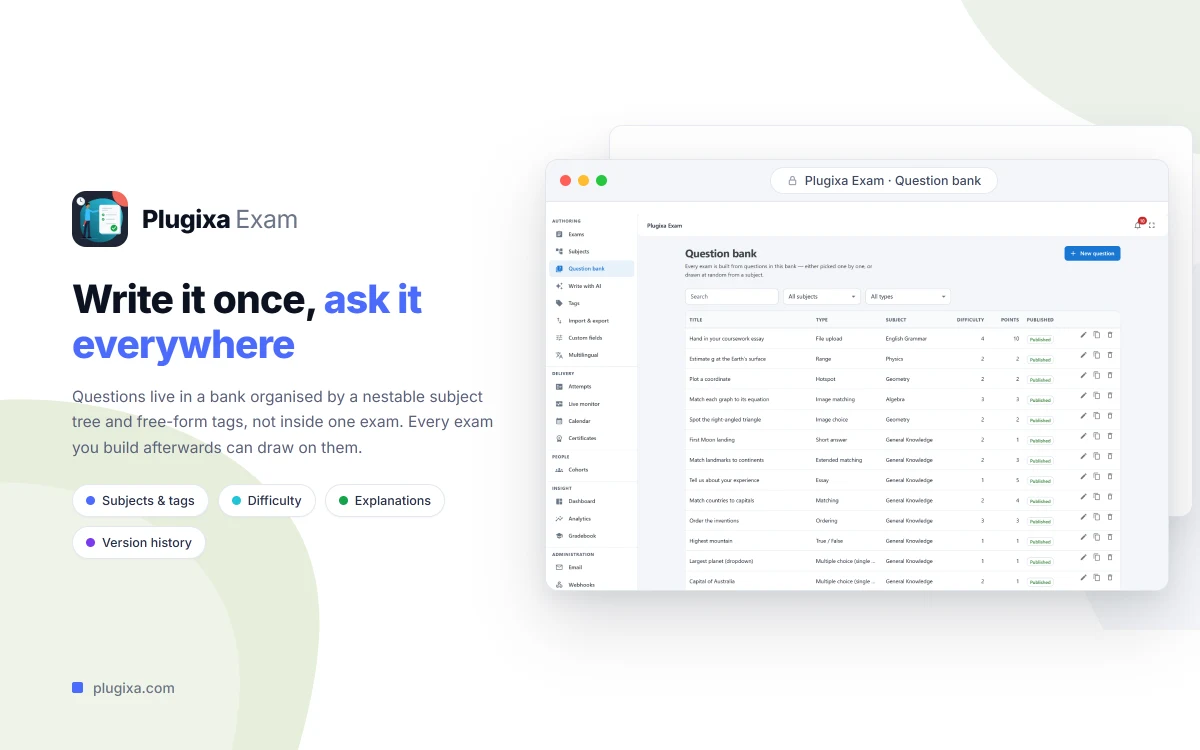
Write it once, ask it everywhere
Questions live in a bank, not inside an exam. Organise them and every exam you build afterwards can draw on them.
-
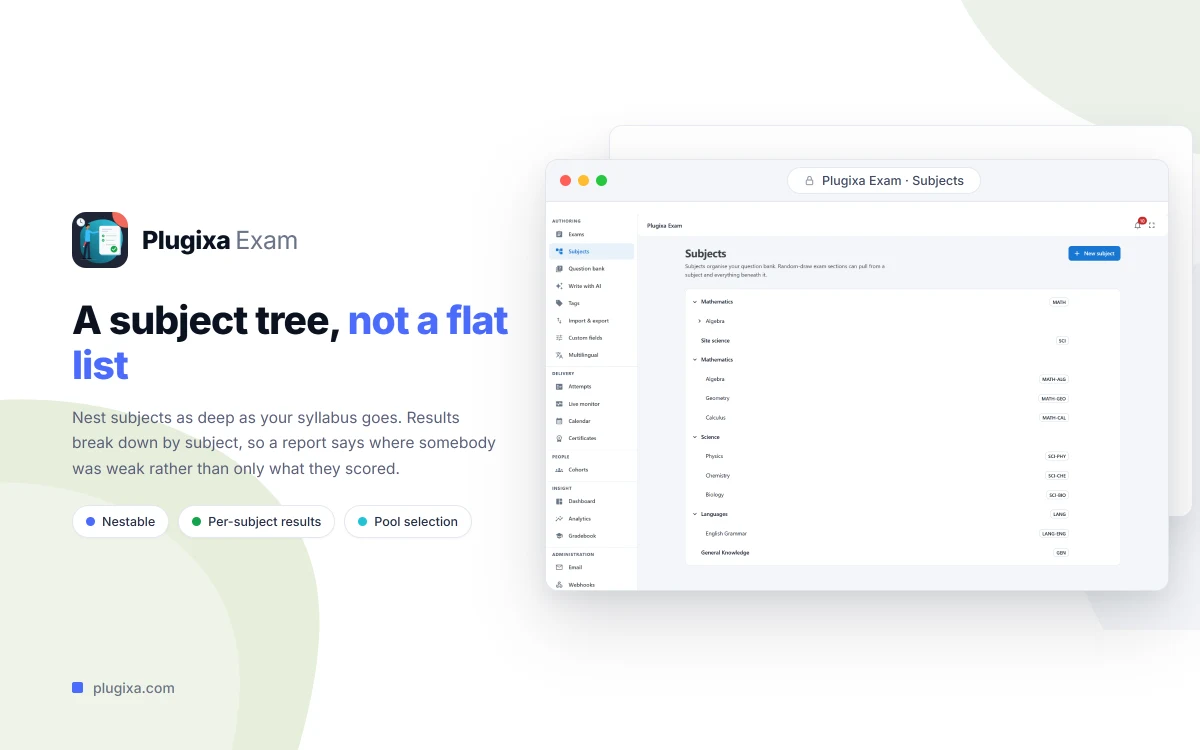
Hierarchical subjects
A subject tree you can nest as deep as your syllabus goes. Results break down by subject, so you can see where a cohort is weak.
-
Free-form tags
Tag a question with anything - difficulty, topic, exam board, year. Pools select on tags as well as subjects.
-
Rich text and explanations
Stems, explanations, exam instructions and pass or fail messages are written in WordPress's own editor, not a plain textarea.
-
Images in questions
Upload straight from the question editor. Files are checked by decoding them, not by trusting the name, so a site that allows SVG elsewhere still cannot put one in an exam.
-
Version history Pro
Every edit to a question is kept by default, so you can see what a paper actually asked at the time somebody sat it.
-
Custom fields Pro
Attach your own data to questions and exams through fieldsets, and use it in reports.
-
Maths and LaTeX Pro
Write LaTeX in stems, options, explanations and rubrics. Rendered by KaTeX from fonts served by your own site, so it works on a machine with no outside network access.
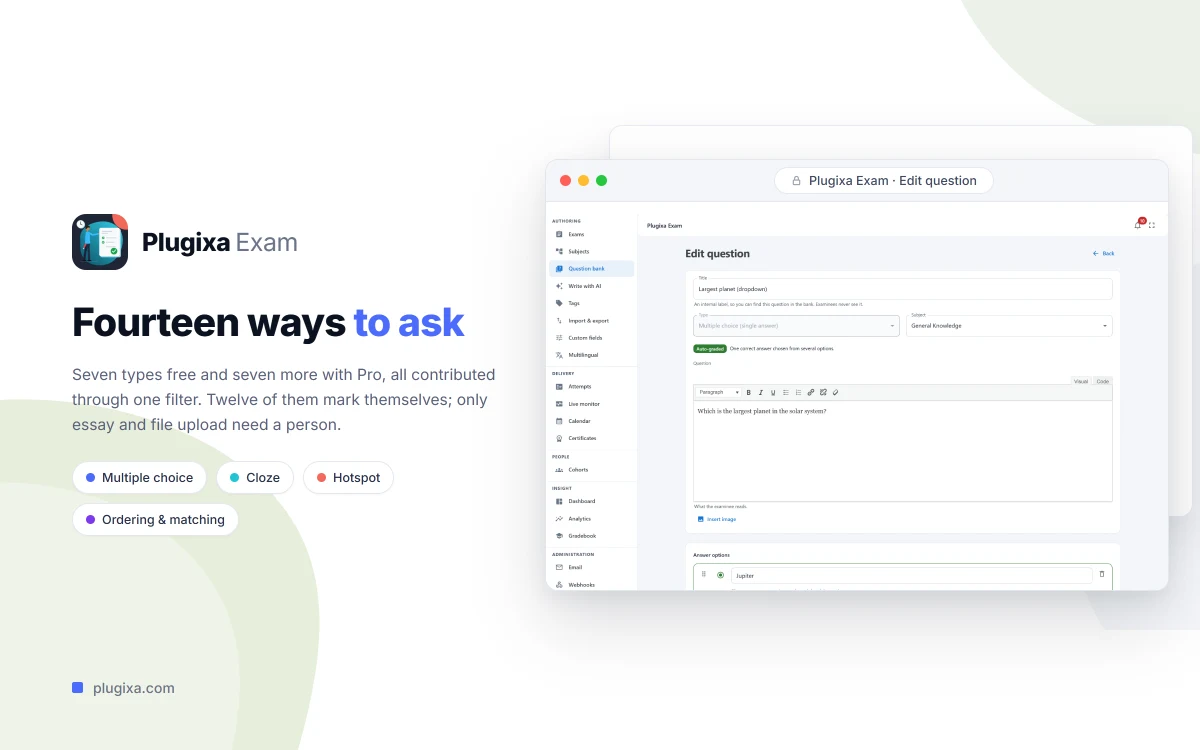
Fourteen ways to ask
Seven types free and seven more with Pro, all contributed through the same filter. An unregistered type still renders, exports and grades, so a downgrade never breaks existing questions.
-
Multiple choice, one answer or several
The two workhorses, with options shuffled independently of the questions around them.
-
True/false, short answer and essay
Short answers match case-insensitively, numerically with a tolerance, or against a regular expression. Essays carry a rubric.
-
Fill in the blanks
A passage with gaps, where each blank carries its own list of accepted answers.
-
Picture choice
The options are images rather than text. Each one asks for a description for people who cannot see it, and a site can make that required.
-
Ordering, matching and extended matching Pro
Put items in sequence, pair them up, or answer several stems from one shared option list. All marked automatically.
-
Hotspot, image matching and range Pro
Mark a point or drag out an area on a picture, pair images together, or answer with a number inside a band. Hotspot has a grid fallback so it works without JavaScript.
-
File upload Pro
Candidates hand in coursework, portfolios, spreadsheets or code. Files are kept out of the media library, behind a permission-checked route.
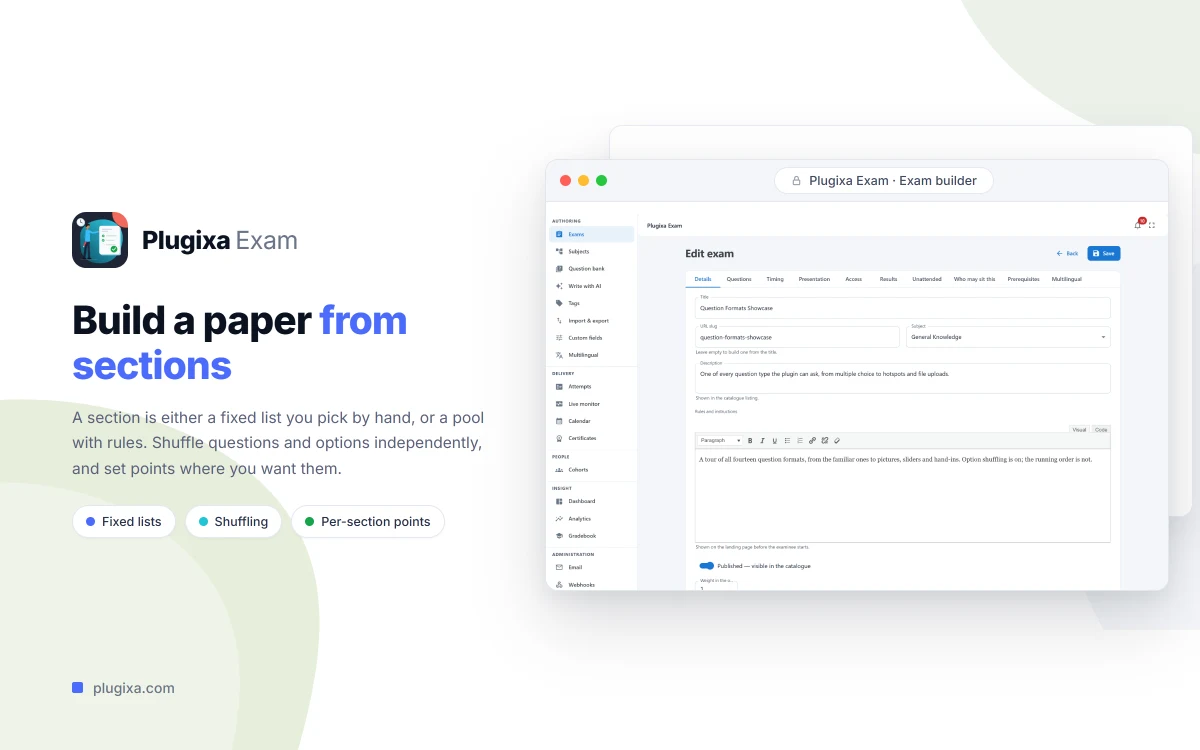
Fixed lists, random pools, or both
An exam is made of sections, and each section decides for itself whether every candidate sees the same questions.
-
Pick questions by hand
A fixed section is an ordered list. Use it for the questions everybody must answer.
-
Describe a pool instead
Give the rules - subject, tag, difficulty, type, how many to draw - and each candidate draws their own paper when they start.
-
Shuffle questions and options
Independently, per exam. The shuffle is seeded per attempt, so a candidate who reloads sees the same paper, not a new one.
-
Points where you want them
Points resolve from the exam question, then the pool's per-question value, then the question's own default.
-
Prerequisites Pro
An exam can require that another has been sat, passed, or scored above a mark first.
-
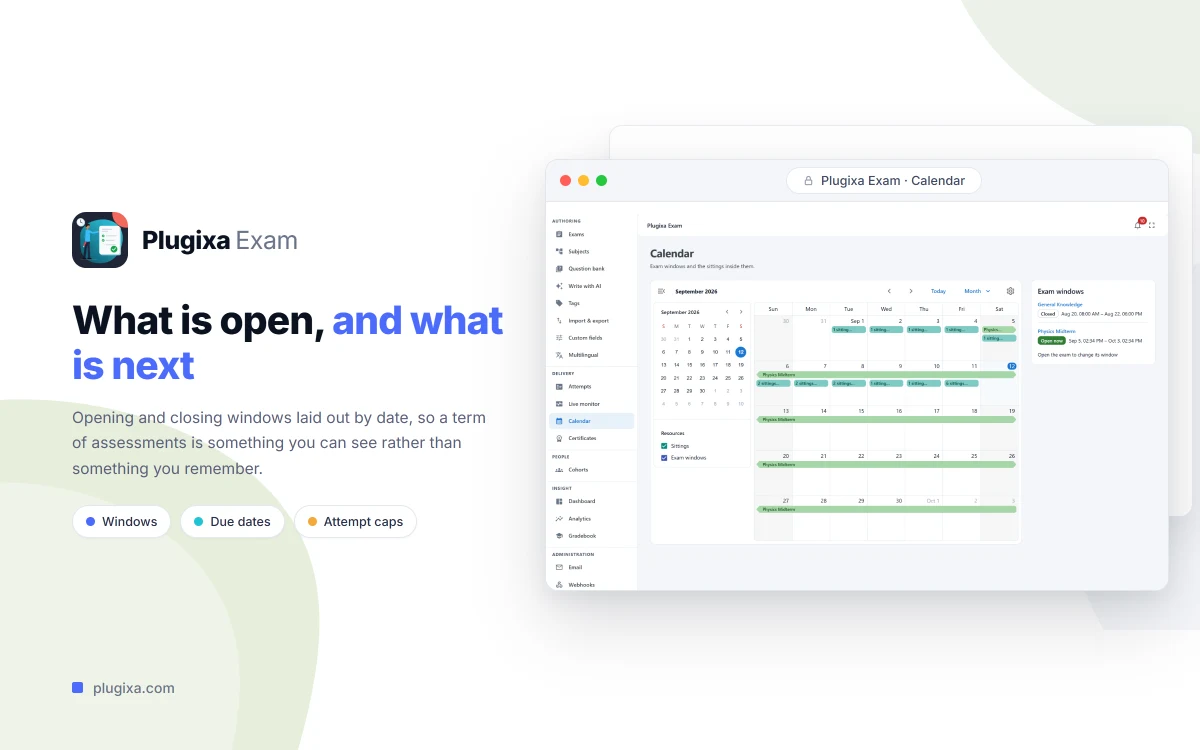
A schedule you can see
Opening and closing windows laid out across a calendar, so a collision or an empty fortnight is obvious rather than buried in a list.
An exam that behaves like an exam
The parts candidates can see are not the parts that decide anything.
-
The clock is on the server
The deadline is computed and stored when the attempt starts, and every write checks it. The countdown in the browser is decoration.
-
The paper is frozen at the start
Questions, order, points and settings are captured into the attempt. Editing an exam half way through changes nothing for whoever is already answering.
-
Autosave as they work
Answers are saved as they go, so closing the browser loses nothing. They return and carry on, up to the time limit or the exam's closing time.
-
Pause, resume and sweep
Freeze the clock and reopen later if you allow it. An abandoned attempt is closed by a scheduled sweep rather than sitting open for ever.
-
No JavaScript, no problem
The runner degrades to an ordinary form post, so a candidate on a locked-down machine still finishes their paper.
-
Practice mode Pro
Untimed attempts with per-question feedback, so learners can rehearse without it counting.
Marked on submit, released on your terms
Everything a machine can mark is marked the moment the paper is handed in. What needs a person goes into a queue.
-
Automatic marking
Twelve of the fourteen types self-grade, including ordering, matching, hotspot and fill in the blanks. Only essay and file upload need a person.
-
Partial credit and negative marking
Proportional or all or nothing, with numeric tolerance, regular expression matching, and an optional floor so a paper cannot score below zero.
-
A marking queue with the rubric
Essays, and anything else you have chosen to mark by hand, arrive in a queue with the rubric beside them.
-
Release when you decide
Immediately, when the exam closes, on a date you choose, or only when you say so. A withheld score is never leaked by a total that moves.
-
Gradebook and transcripts Pro
Letter grades with their own boundaries, points and colours. A learner's portal shows a weighted transcript across everything they have sat.
-
Opt-in leaderboards Pro
Public rankings for one exam, which nobody appears in unless they choose to. A ranking of volunteers is a game; a ranking of everybody is something else.
Decide exactly who sits it
Four ways in as standard, plus cohorts on Pro. Every limit is enforced on the server.
-
Open to everybody
Publish the exam and anyone can sit it. Good for practice papers and public self-assessment.
-
Signed in, by role
Restrict to logged-in users and choose which roles qualify.
-
An access code
Share one code with a room. No accounts to create, no invitations to send.
-
Named guests
They give a name and an email and are identified by a signed cookie. No PHP session is used, so page caching is not broken for everyone else.
-
Attempt caps and cooldowns
Limit how many times somebody can sit an exam, make them wait between attempts, or both.
-
Cohorts Pro
Hand-picked lists of people, for exams that belong to a class rather than to a site.
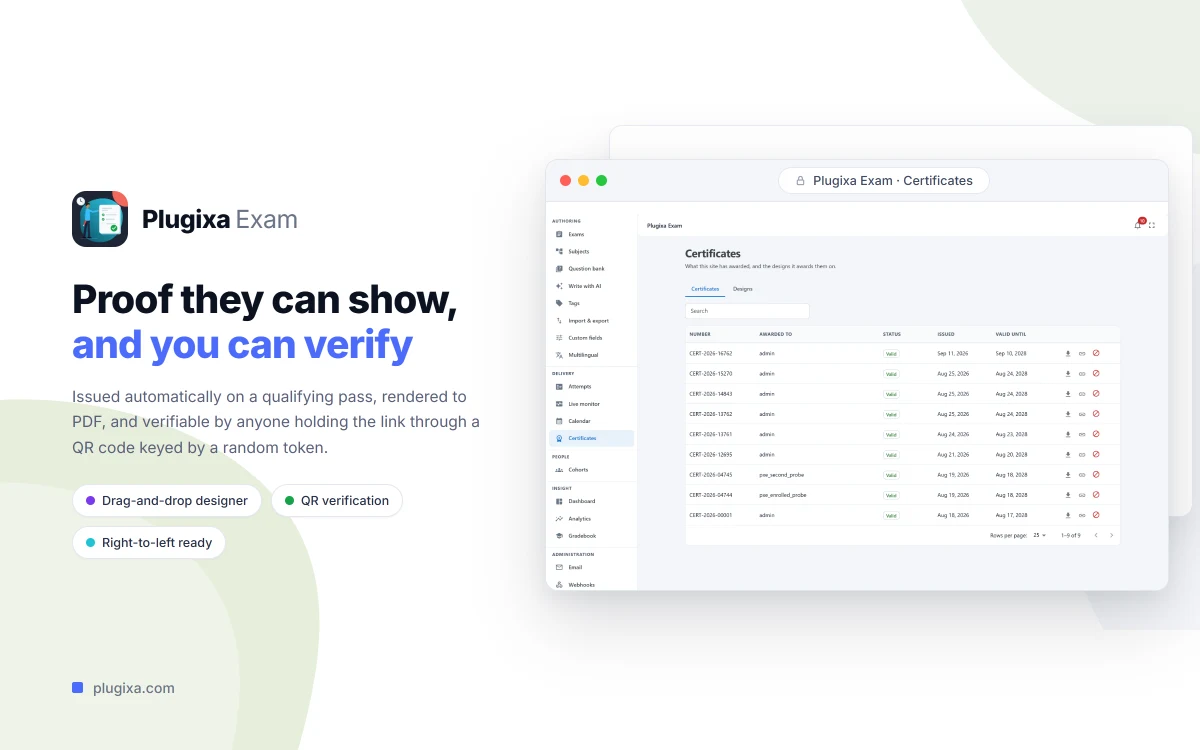
Proof they can show, and you can verify
Certificates are issued on a qualifying pass, rendered to PDF, and verifiable by anyone holding the link - all of it in the free version. Pro is where you design them.
-
Drag-and-drop designer Pro
Lay the certificate out visually instead of typing coordinates, keep as many designs as you like, and give each exam its own. The free version ships one design and lets you edit every part of it.
-
Issued on a pass
Awarded automatically when a result qualifies, so nobody has to remember to send one.
-
Public QR verification
Every certificate carries a QR code to a public verification page keyed by a random token, not a guessable serial number.
-
Right-to-left rendering
The PDF engine shapes Arabic and reorders bidirectional text properly, so a certificate is not a row of disconnected letterforms.
-
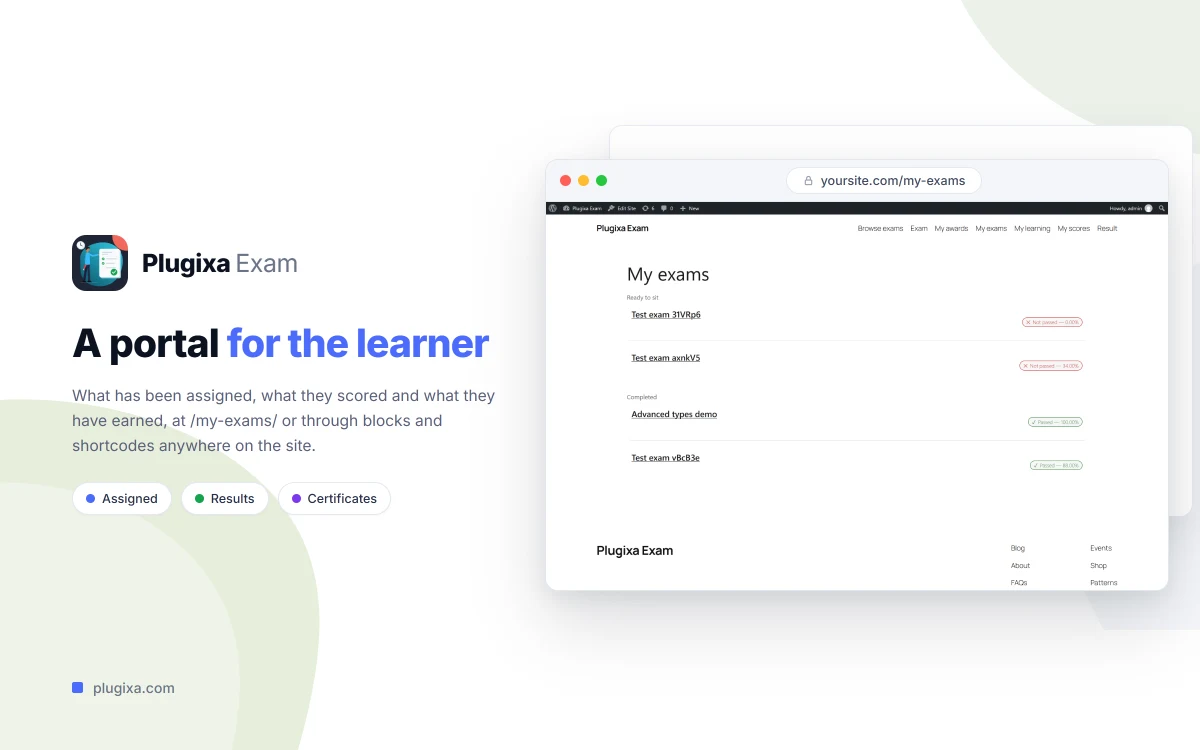
A wallet in the portal
Learners see everything they have earned at /my-exams/, or through the certificates block anywhere on the site.
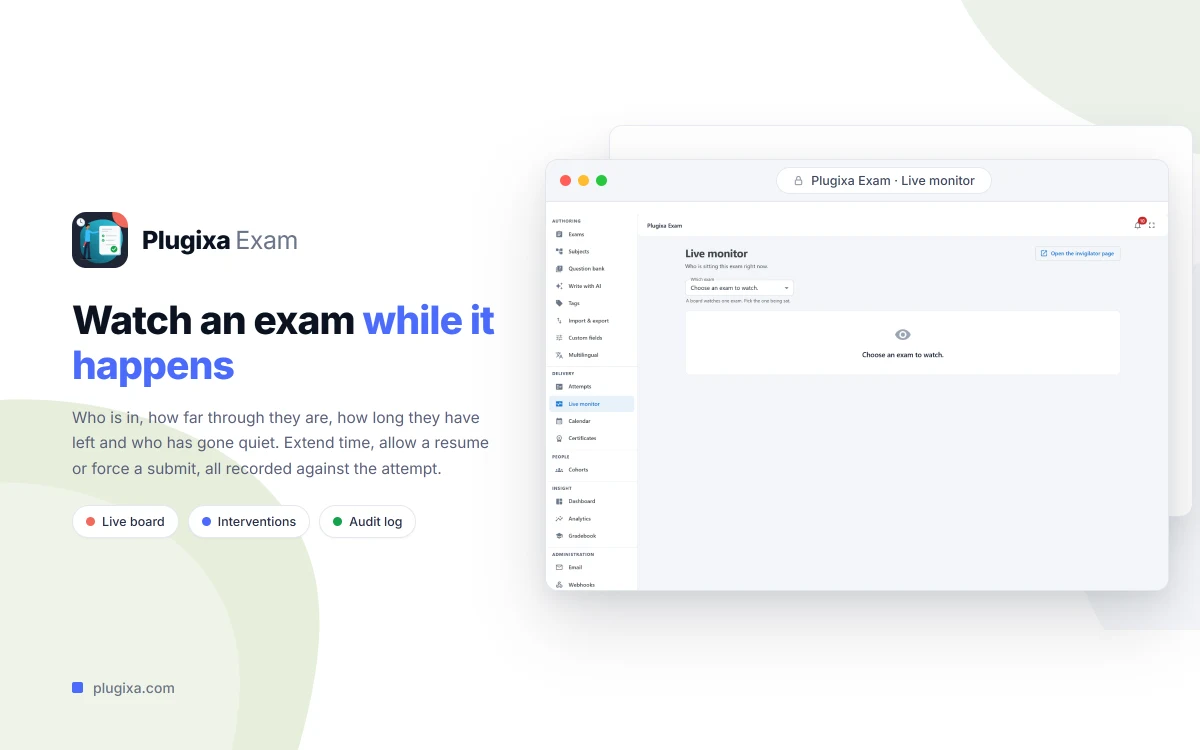
Watch it happen, then find out what the questions did
A live board while the exam is running, and item analysis once it is over.
-
Live invigilation board Pro
Who is in, how far through they are, how long they have left, and who has gone quiet.
-
Intervene mid-exam Pro
Extend time, allow a resume, or force a submit, with every action recorded against the attempt.
-
Item analysis Pro
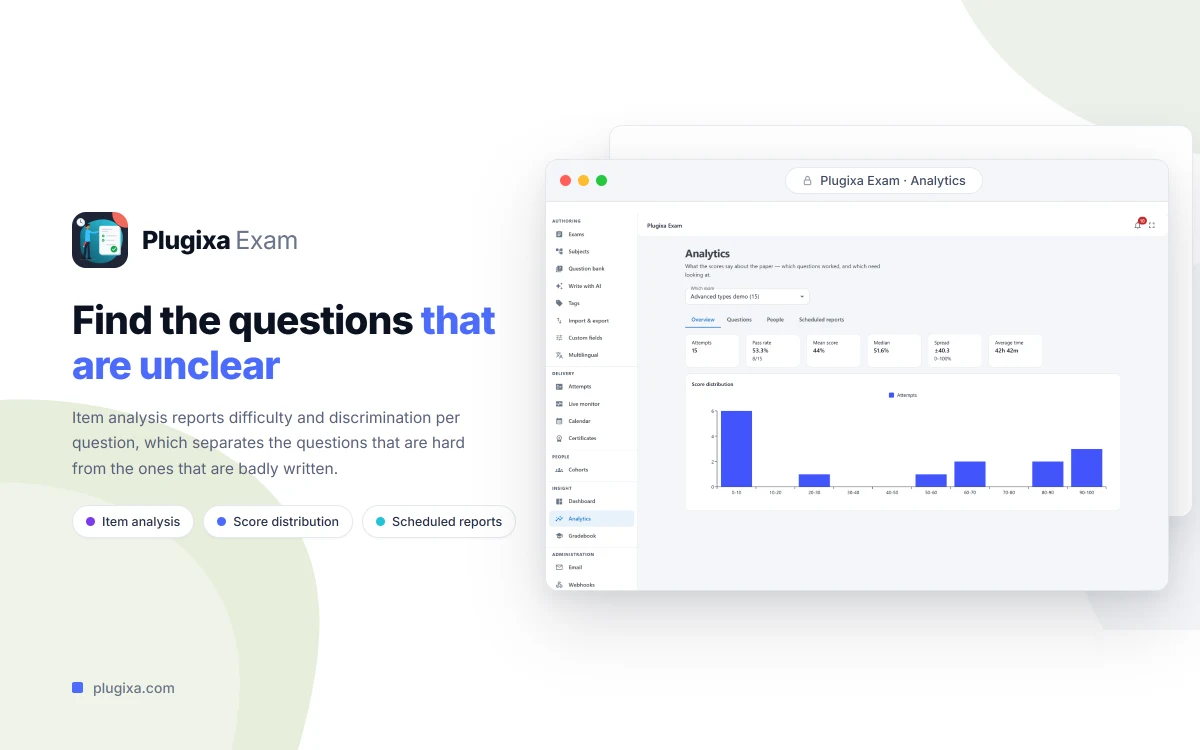
Difficulty and discrimination per question, so you can find the ones that are badly written rather than hard.
-
Scheduled reports Pro
Have the numbers arrive by email on a schedule instead of remembering to go and look.
-
Integrity signals Pro
Record the signals worth recording, and let a human decide what they mean. Nothing is auto-accused.
Plugs into the LMS you already run
None of these contact anything until an administrator has entered an address or a key.
-
Tutor LMS, LearnDash and LifterLMS Pro
Restrict an exam to learners enrolled on a course, and mark that course complete when they pass. Inert when the LMS is not installed.
-
LTI 1.3 Pro
Launch an exam from Moodle, Canvas or anything else that speaks LTI 1.3, and pass the grade back.
-
Signed webhooks Pro
Outbound notifications on submit, grade and certificate issue, each request signed, with an SSRF guard on the address you enter.
-
API tokens Pro
Bearer tokens with thirteen per-scope permissions, default deny, so external automation can work without a browser session.
-
AI question drafting Pro
Paste a syllabus and review the drafts. Uses your own API key with OpenAI, Anthropic or any OpenAI-compatible endpoint, including a model on your own machine.
Server-rendered, translatable, yours to extend
It behaves like a WordPress plugin rather than an app that happens to live in one.
-
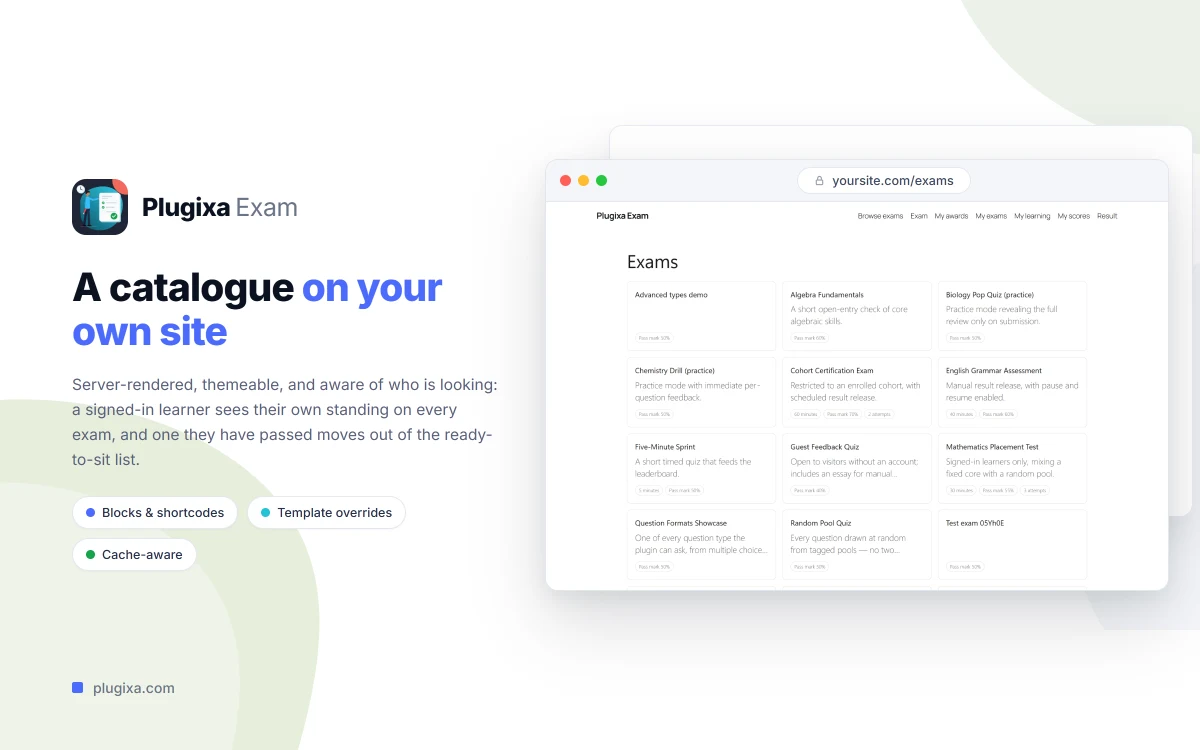
Blocks and shortcodes
Five blocks and ten shortcodes covering the catalogue, a single exam, search, results and the learner portal. Pro adds one of each.
-
Template overrides
Every front-end template can be overridden from your theme, so the exam pages match the rest of the site.
-
Translated to the last screen
Admin, runner, block controls, front-end templates and notification emails all read one text domain. Arabic, French, German and Spanish are bundled, with right-to-left layouts.
-
GDPR built in
Exporters and erasers, so a personal data request made through WordPress's own tools includes and removes exam data too.
-
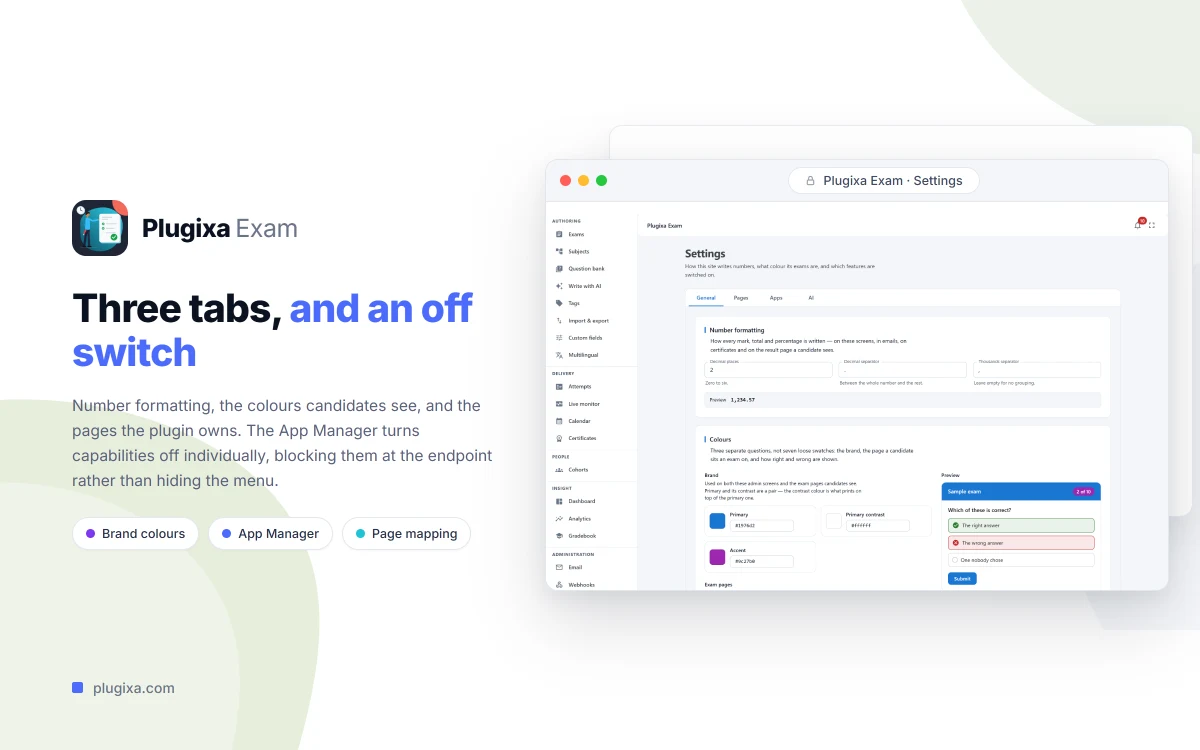
Turn any of it off
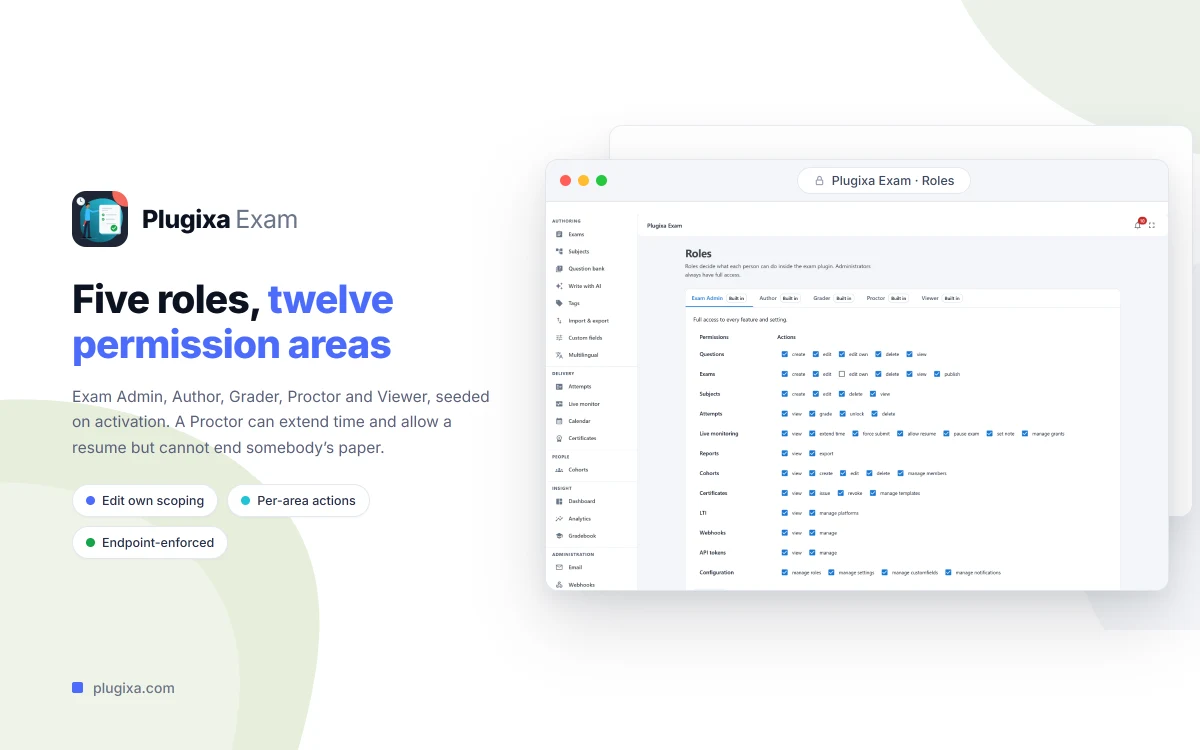
The App Manager switches capabilities off individually, and a capability that is off is blocked at the endpoint, not merely hidden from the menu.
-
In-app alerts
A bell in the admin bar for papers waiting to be marked, and a shortcode that gives learners their own feed. Not everything deserves an email.
-
Found by the rest of WordPress
Exams are added to the site search index and appear in the block editor's link picker, so an exam is findable the same way any other content is.
Simple pricing
Choose your growth plan
Start building with Plugixa Exam today. Upgrade anytime as your needs grow.
Free
Free forever
A complete exam plugin, not a trial
- Question bank with subjects & tags
- Seven question types, including essay
- Fixed sections & random pools
- Server-timed runner with autosave
- Automatic marking & manual queue
- Four access modes, caps & cooldowns
- Learner portal, 5 blocks & 10 shortcodes
- Import & export CSV, Aiken, GIFT, Moodle XML, QTI
- Schedule calendar & in-app alerts
- Community support
Pro
1-Year License
Invigilation, analytics, certificate designer and LMS bridges
- Everything in Free
- Seven more question types, for fourteen
- Certificate designer, unlimited designs, one per exam
- Live invigilation board with interventions
- Analytics, item analysis & scheduled reports
- Gradebook with letter grades & transcripts
- Tutor LMS, LearnDash & LifterLMS bridges
- LTI 1.3, webhooks & API tokens
- AI question drafting with your own API key
- Cohorts, prerequisites & custom fields
- Multilingual content & practice mode
- LaTeX maths rendering
- Opt-in leaderboards
- Demo dataset to explore
- 1 year of updates
- Priority email support
Instant Digital Delivery
Download immediately after checkout
Secure Payment
Encrypted, PCI-compliant checkout
Auto-Updates
One-click updates from WordPress admin
Trusted by Pros
Used on thousands of WordPress sites
FAQ
Frequently asked questions
Getting Started
/exams/, plus a
learner dashboard at /my-exams/, and there are five blocks and ten shortcodes if you would
rather place the catalogue, a single exam, search or results on pages of your own.