


Plugixa CRM
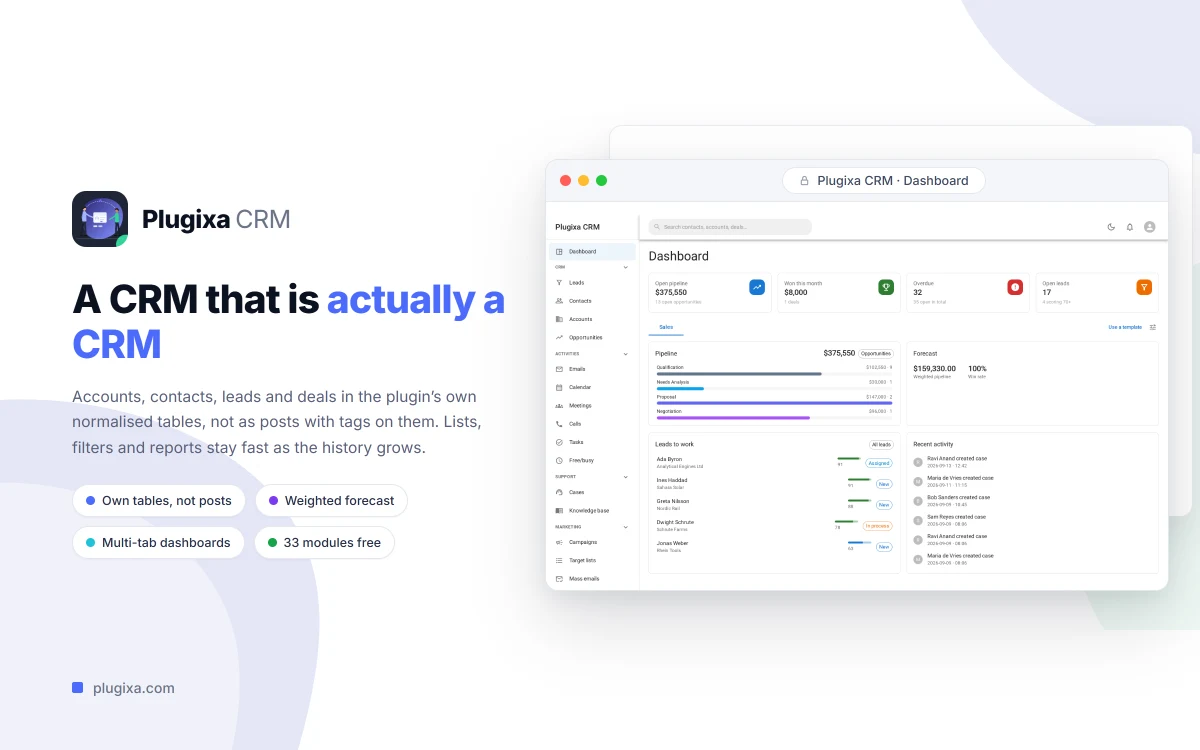
Most WordPress CRMs are a contact list with tags on it. They store people as posts, treat a company as a text field, and call an order on a contact a relationship. That is fine until somebody asks which deals close this quarter, who last spoke to the account, or why a figure in a report disagrees with the record it came from. Plugixa CRM is built the other way round: accounts and contacts in the plugin’s own normalised tables, deals on a pipeline with stages and probability, and every record carrying its own notes, files, tags, followers and audit trail.
The free edition is the CRM, not a trial of one. Thirty-two modules: leads that convert into an account, a contact and an opportunity in one step; tasks, calls and meetings on a single calendar with working hours and free/busy; email sent from a record and received over IMAP, with incoming mail turned into cases and matched on Message-ID so a message read twice is stored once; campaigns and mass email whose unsubscribe link cannot be switched off; cases and a knowledge base; reports, dashboards, teams and roles with field-level rules.
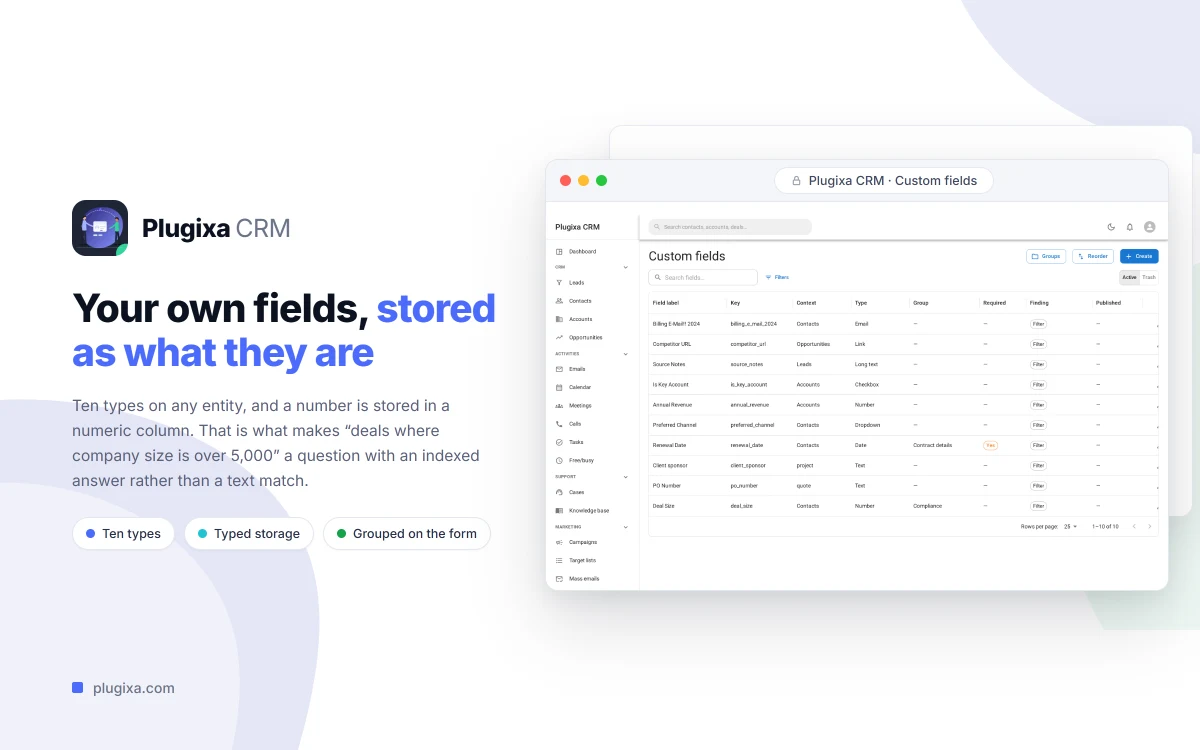
Paid adds the connectors and custom fields: your site’s own contact forms, Google Calendar, Microsoft 365, Twilio and WooCommerce, plus fields you define yourself on contacts, accounts, leads and deals. There is no licence check anywhere in this plugin, because the free build simply does not contain the premium directory. Nothing is switched off waiting for payment. And the whole thing serves three audiences from one install: staff in the admin or on a page of your own site, customers in a portal where every panel is off until you turn it on, and anybody at all reading a knowledge base rendered on the server with no endpoint to defend.



Screenshots
See it in action
Features
Everything you need
Who you sell to, and what you are selling them
Companies, people and deals in the plugin's own normalised tables, so a database of thousands stays as fast as a database of ten.
-
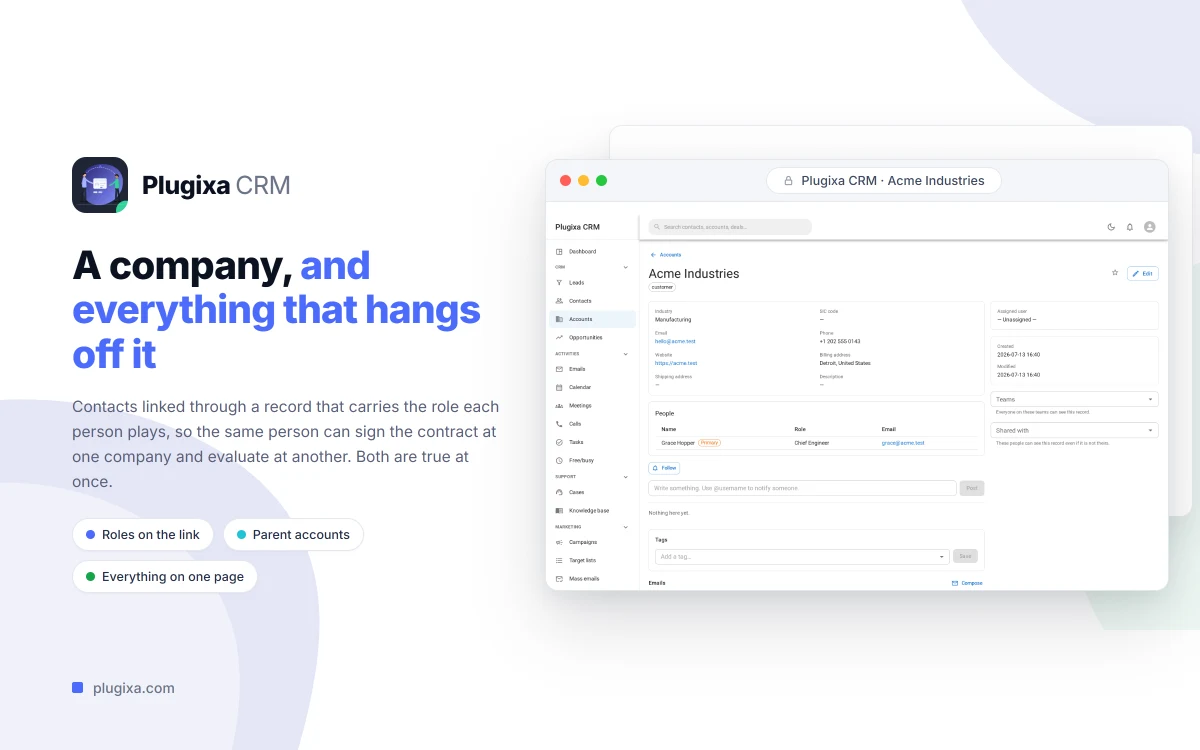
Accounts and contacts
Companies and the people at them, linked through a pivot that records the role each person plays rather than forcing one contact into one company.
-
As many emails and numbers as they really have
Contact points live in their own tables, so a person can have a work address, a personal one and two phones, with one of each marked primary.
-
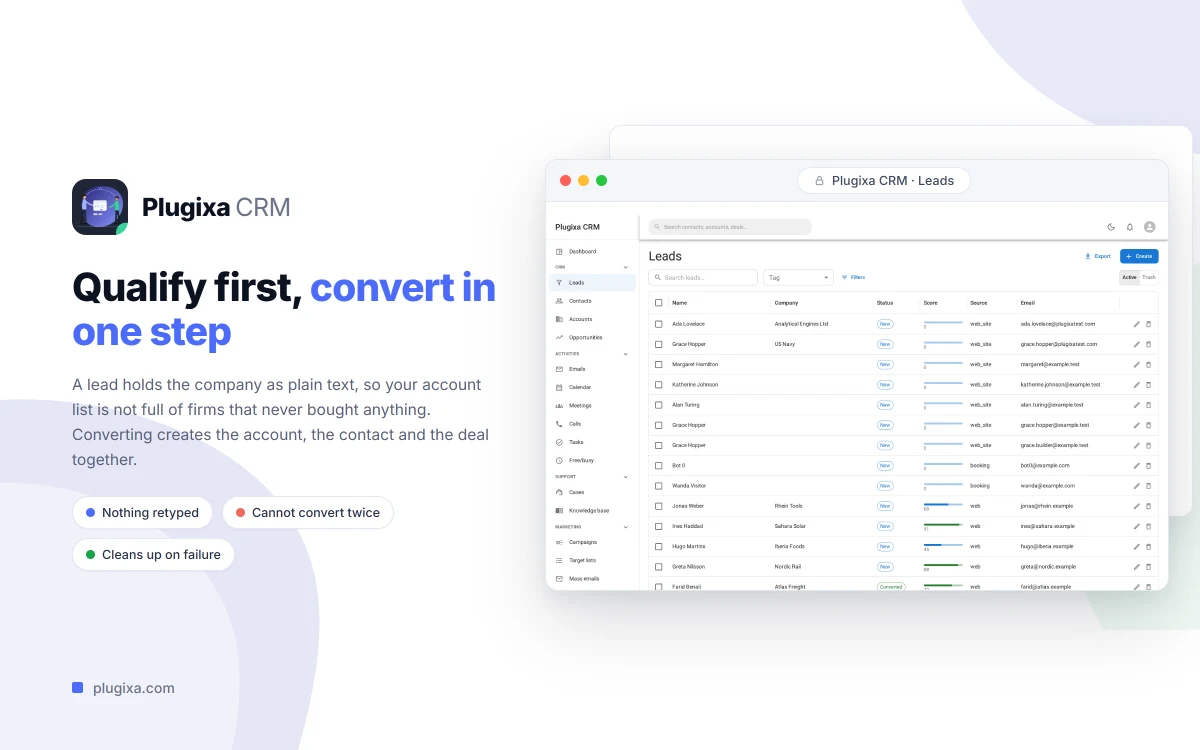
Leads that convert in one step
A qualified lead becomes an account, a contact and an opportunity together, with nothing retyped and nothing orphaned behind it.
-
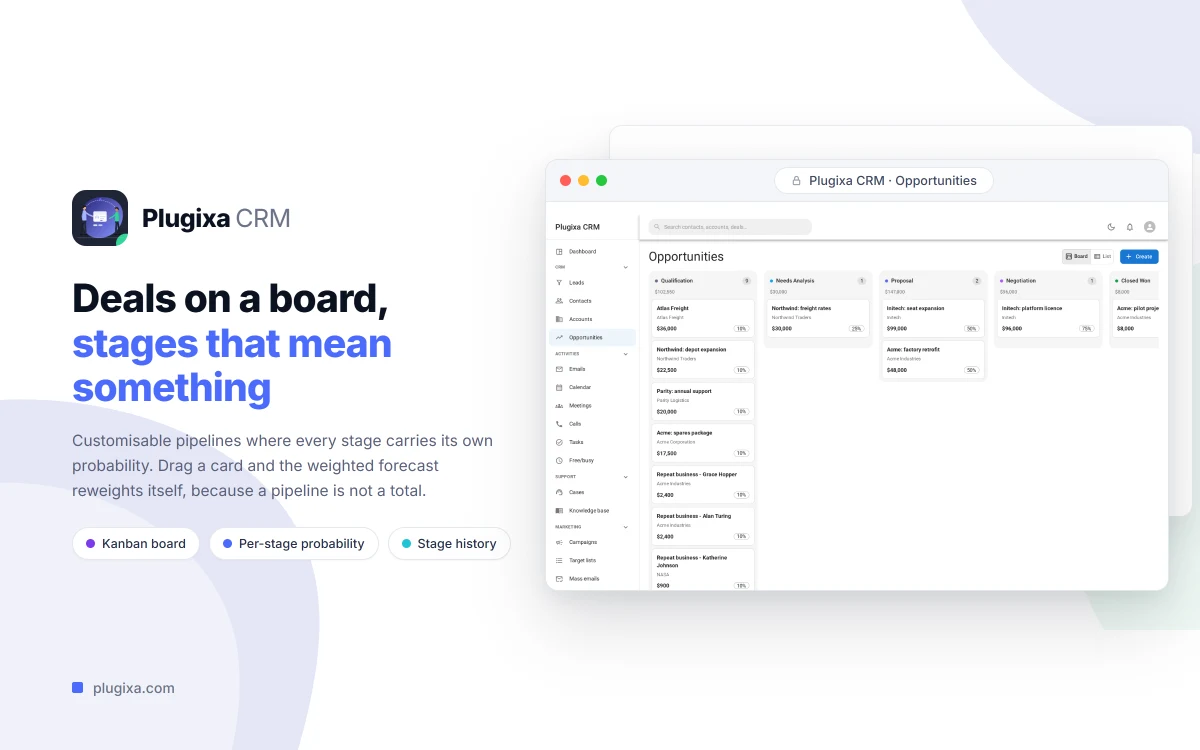
Deals on a drag-and-drop board
Customisable pipelines and stages, each with its own probability. Move a card and the weighted forecast reweights itself.
-
Duplicate finder and merge
Find the same company entered twice and merge them, bringing the notes, files, activities and stars of both onto the survivor.
Everything that has a time on it
Three kinds of activity, one calendar over all of them, and an honest answer to when somebody is actually free.
-
Meetings and calls
Both carry attendees and a status; a call also carries its direction. Each is anchored to a start and an end rather than a single date.
-
Tasks
A due date, a priority and an assignee. No attendees, because a task is something one person owes rather than something people attend.
-
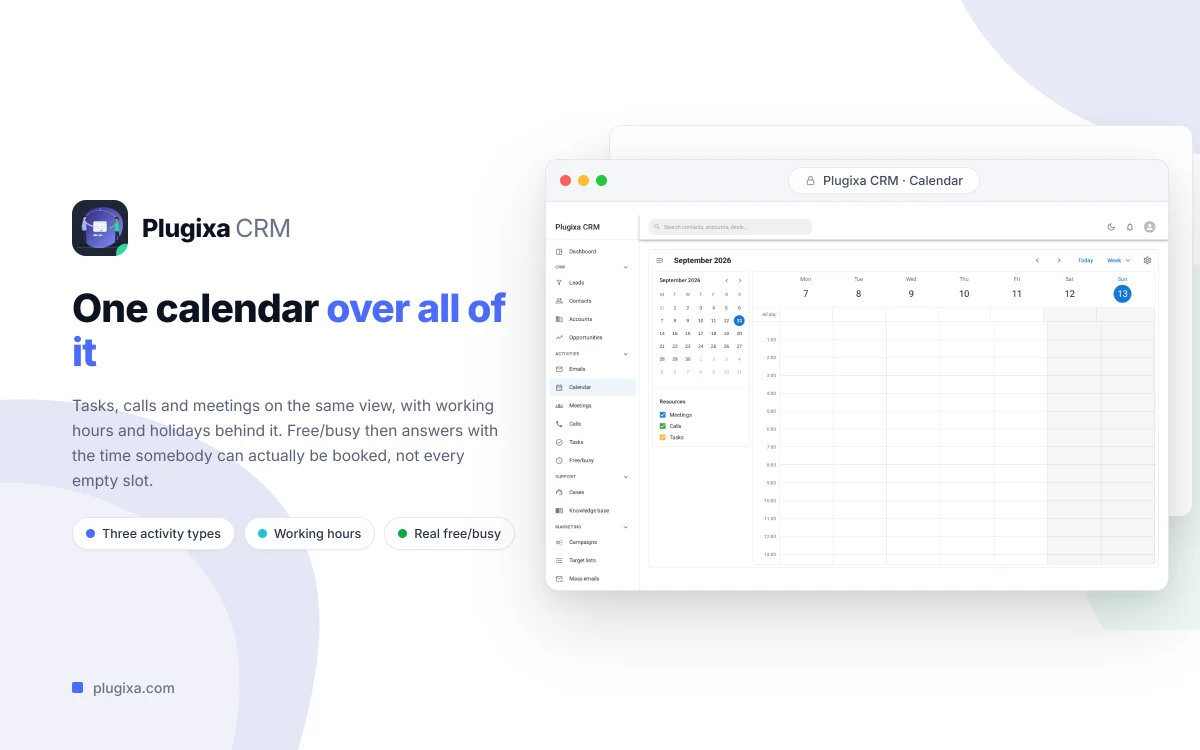
One calendar over all of it
Month, week and day, drawing tasks, calls and meetings together, so the week you are looking at is the whole week.
-
Working hours and free/busy
Business hours and holidays per calendar, so availability answers with the time somebody can actually be booked rather than any empty slot.
-
Reminders, and a bell that collects them
Tell me an hour before this happens, on any record. Reminders land in one inbox per person, and anything in the CRM can put something there.
-
Google Calendar sync Pro
Meetings go out to a signed-in person's Google calendar. Google may say one moved or was called off, and never creates a CRM meeting of its own.
The thread lives on the contact, not in somebody's inbox
Sent from a record, received from your own mailbox, and filed against the person it concerns.
-
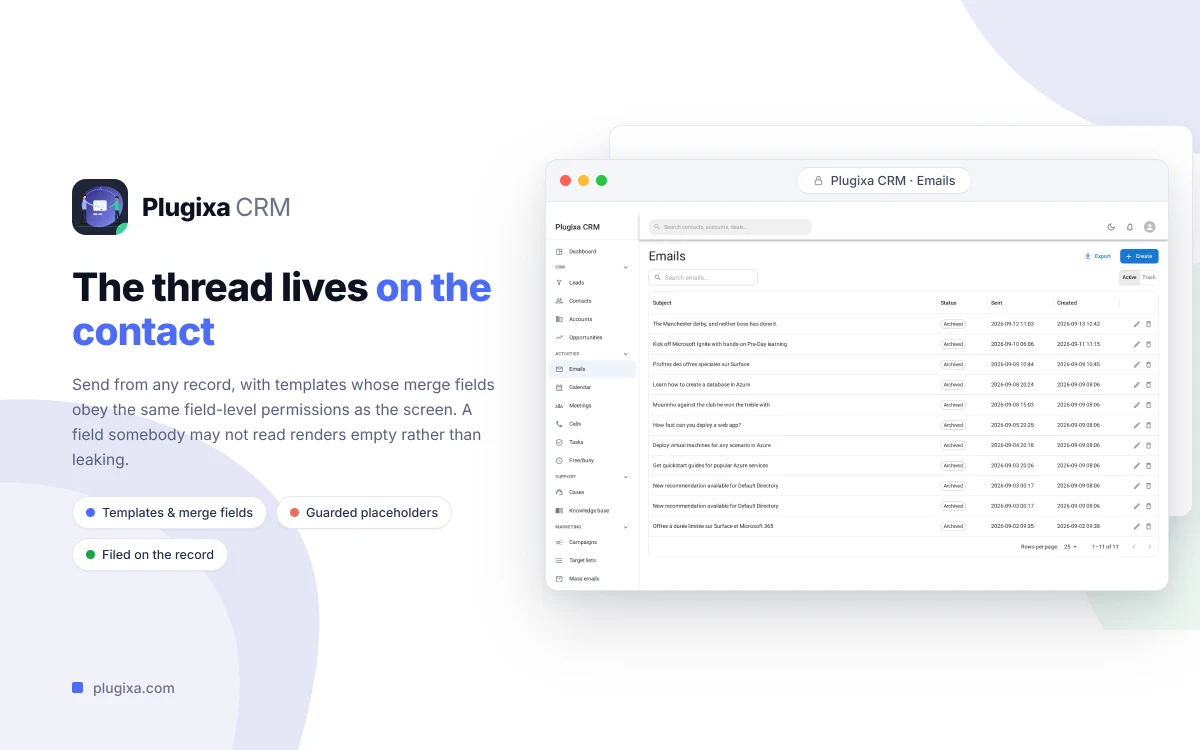
Send from any record
Compose against a contact, a lead or a case and the message is stored where the next person will look for it.
-
Templates with merge fields
Reusable subjects and bodies, organised in categories, that fill themselves in from the record you are sending against.
-
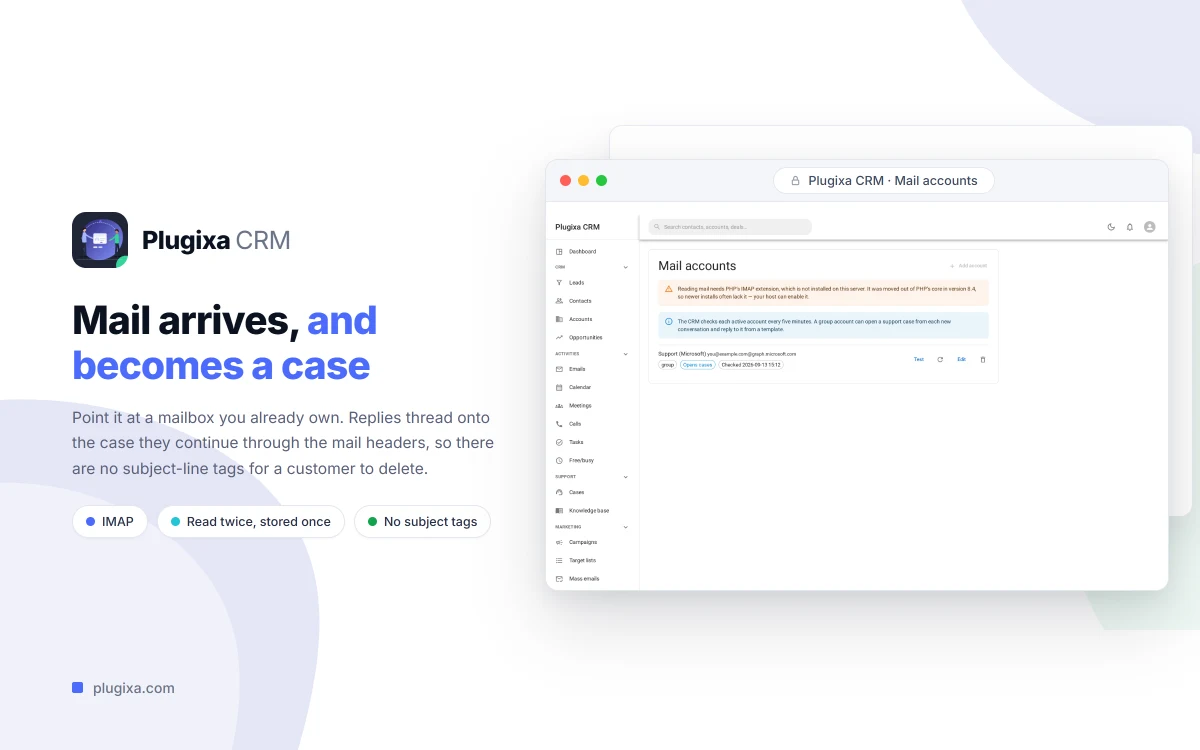
Email-to-case over IMAP
Point the plugin at a mailbox you already own and incoming mail becomes cases, with replies threading onto the case rather than opening another.
-
Read twice, stored once
Messages are matched on their Message-ID, so a folder re-polled after an interruption does not double every conversation in it.
-
A Microsoft 365 mailbox, no password stored Pro
Microsoft switched off password sign-in for mail in 2022. Connect through the same sign-in you use for the calendar instead.
A question, from wherever it arrives
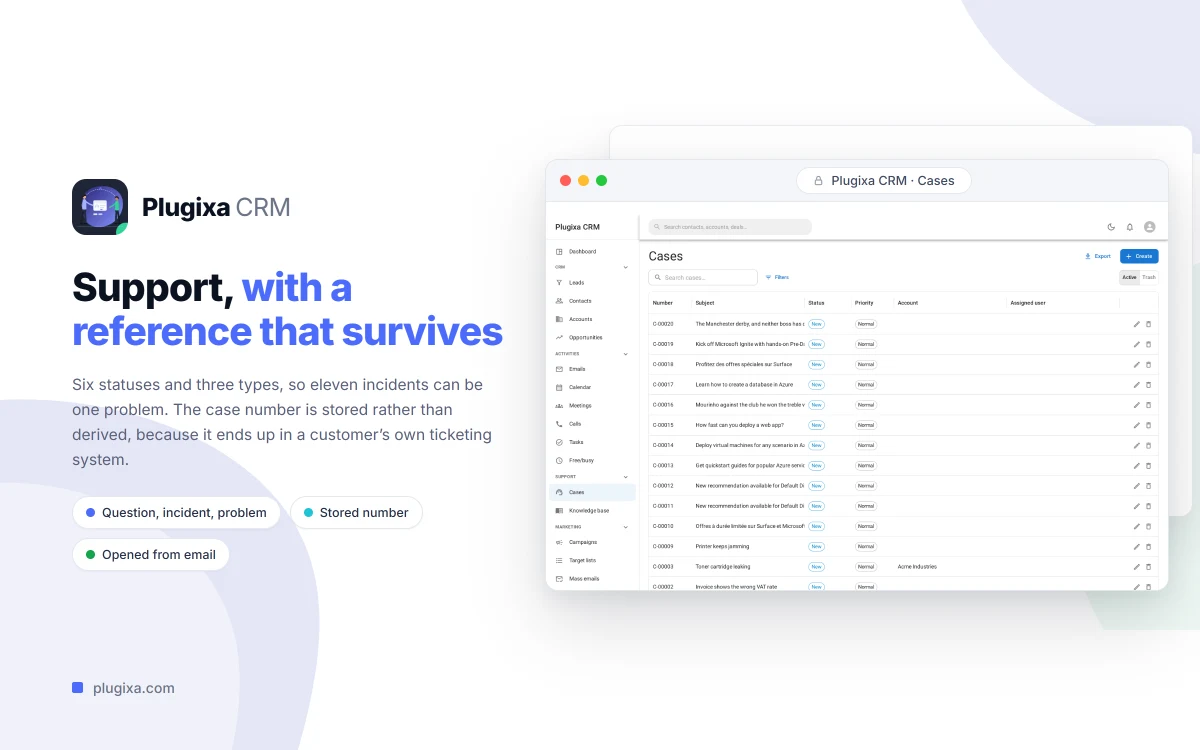
Cases with an owner and a priority, a knowledge base behind them, and a public page for the answers that are not private.
-
Cases
Status, priority, the contact and the account they belong to, and a number sequence you control.
-
A case opened from an inbox
Mail arriving at a monitored mailbox opens a case by itself, so a question sent to an address rather than a form is not lost.
-
Knowledge base
Articles in a category tree, linkable to the cases they answer, so the second person to ask gets a link instead of a retyped reply.
-
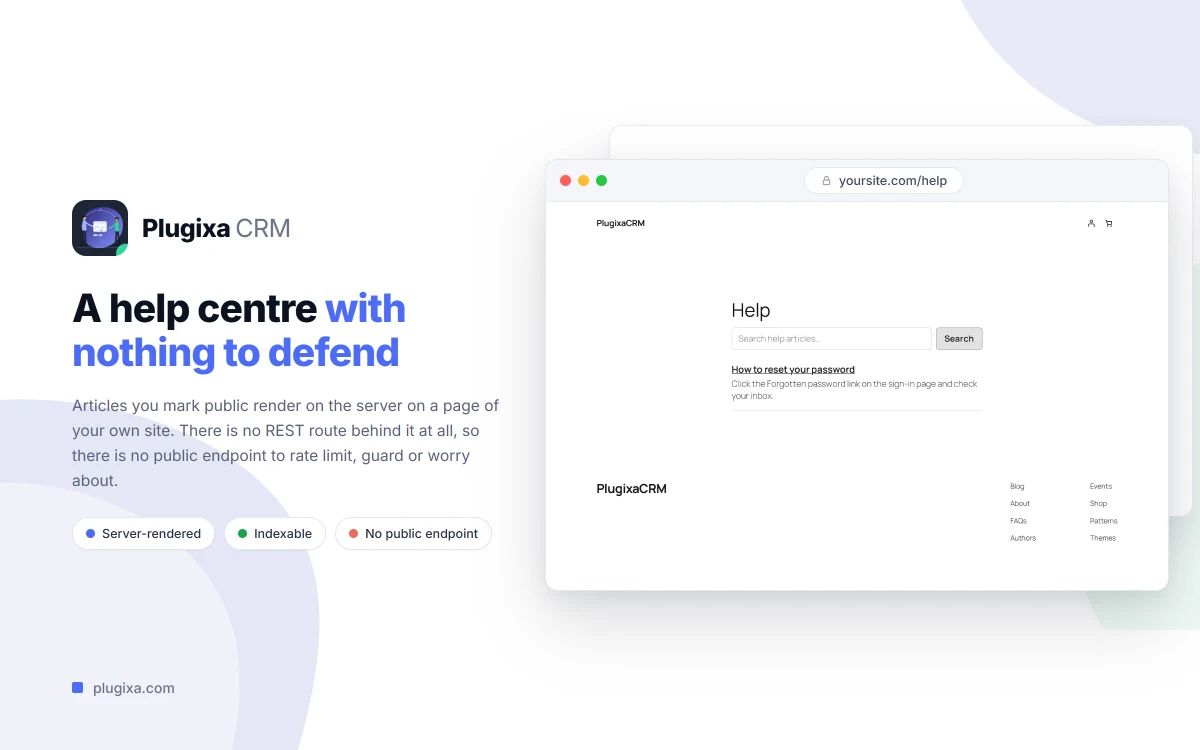
A public help centre, no login
Articles you mark public render on the server on a page of your own site. There is no REST route behind it, so there is nothing public to defend.
Reaching people, and letting them leave
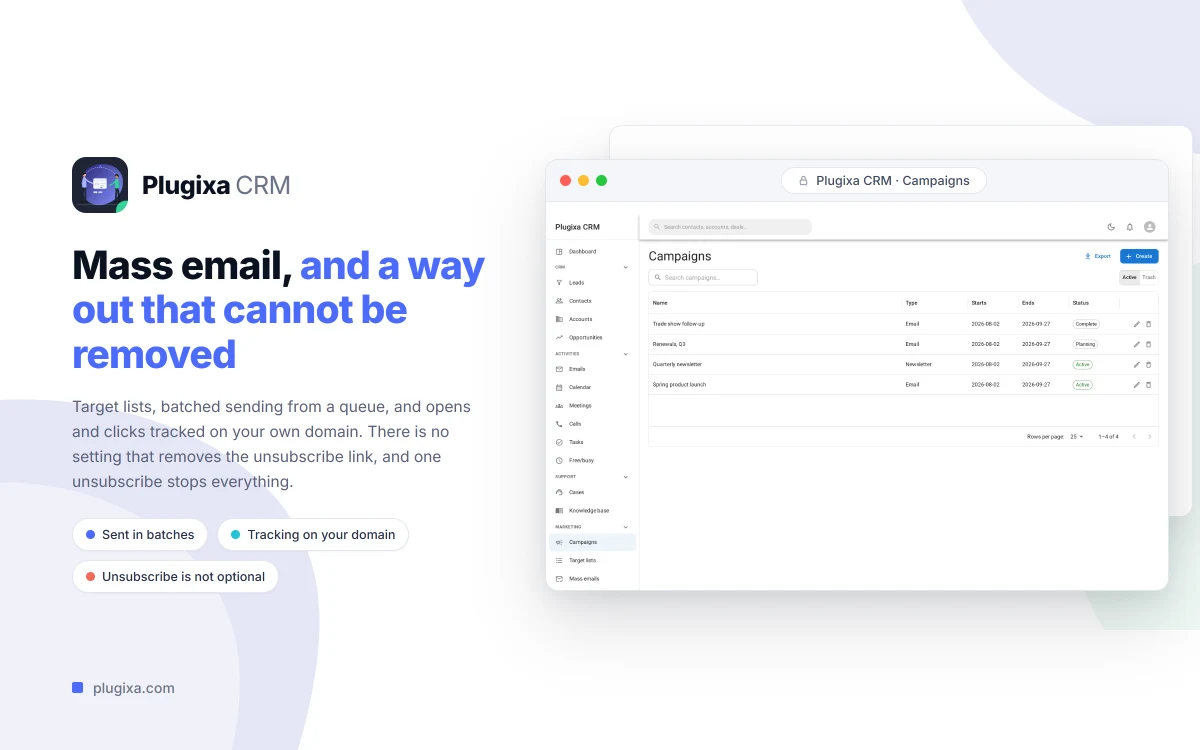
Target lists, mass email and web-to-lead, with the unsubscribe guarantees written into the code rather than into a policy.
-
Campaigns and target lists
Build an audience from contacts, leads and accounts, and report on what the campaign did afterwards.
-
Mass email, sent in batches
A queue drained on cron rather than one long request, so a large send does not depend on a browser tab staying open.
-
An unsubscribe that cannot be switched off
There is no setting to remove the link, and the List-Unsubscribe header goes with it. One unsubscribe stops every campaign, not just this one.
-
Tracking on your own domain
Opens and clicks are recorded by your own site. No third party sees who opened what, because no third party is involved.
-
Your site's own forms become leads Pro
Contact Form 7, WPForms, Gravity Forms and Elementor submissions map into the CRM behind one card, with the mapping set per form.
The same panels, on all of it
Five things that are true of every kind of record, because they are about records rather than about any one kind. Custom fields joins them on a paid build.
-
Notes
Free text on anything, and the same rows the activity stream reads: a note is a stream post rather than a second kind of thing.
-
Files, stored privately
Attachments live outside the media library behind an unguessable name, an inert extension and a server deny rule, with a health check that proves it.
-
One tag vocabulary
The same labels across accounts, contacts, leads, deals and cases, so a tag means one thing everywhere it appears.
-
A stream, and who follows it
Each record has a feed of what happened to it, and the people who asked to be told when it does.
-
Favourites and an audit log
Star what you are working on, and read back who changed which field and when, on any record.
-
Custom fields Pro
Ten field types on contacts, accounts, leads and deals, stored in typed columns so a number sorts as a number and a date filters as a date. Paid: the code is absent from the free download rather than switched off.
The numbers, and the paperwork
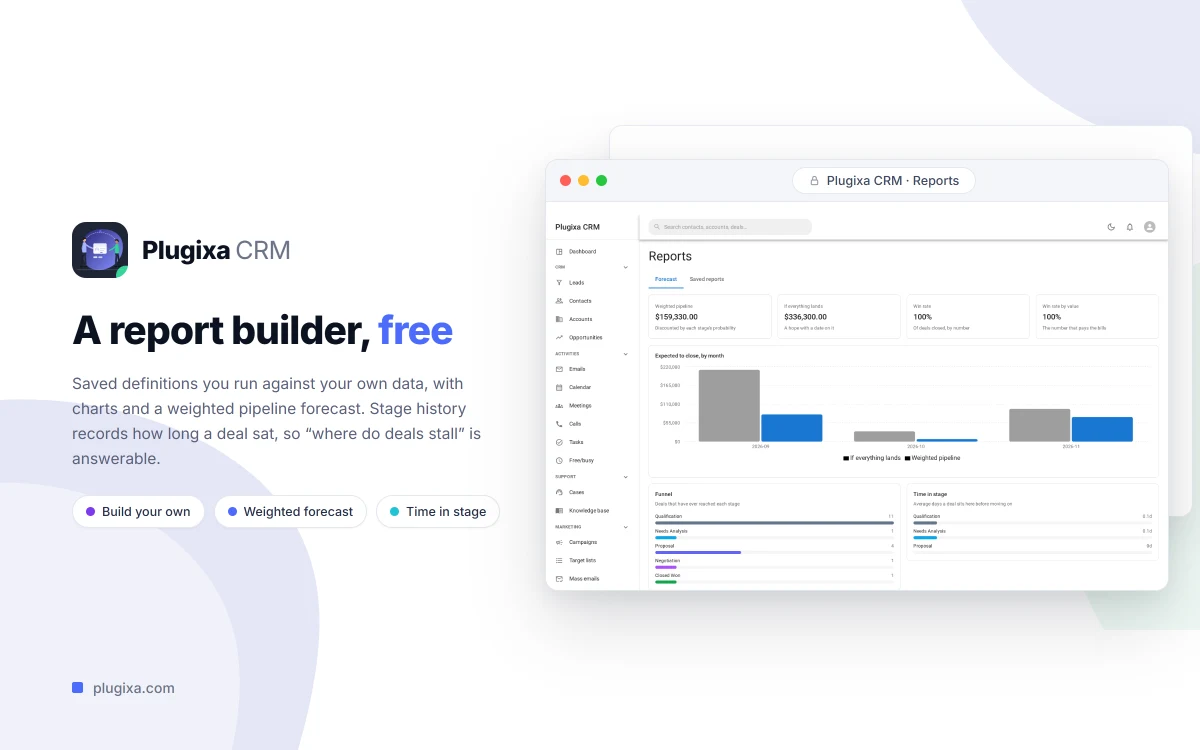
A report builder, arrangeable dashboards, PDF templates and data that goes both ways.
-
A report builder with charts
Saved definitions you run against your own data, rather than a fixed set of reports somebody else chose.
-
Weighted pipeline forecast
Each stage carries a probability, so the forecast is the pipeline discounted by how likely each deal is rather than its face value.
-
Multi-tab dashboards
Arrange the widgets you want, on as many tabs as you want, seeded from templates and saved per person.
-
PDF templates and print
Design a template once and print any record that the template names, without the plugin needing to know what that record is.
-
CSV and Excel, both directions
Import with a column-matching step and errors reported by line number, and export exactly the list you are looking at.
Who may see what, decided per action
A matrix rather than a switch, down to the field, with the audit trail and the erasure tools that go with it.
-
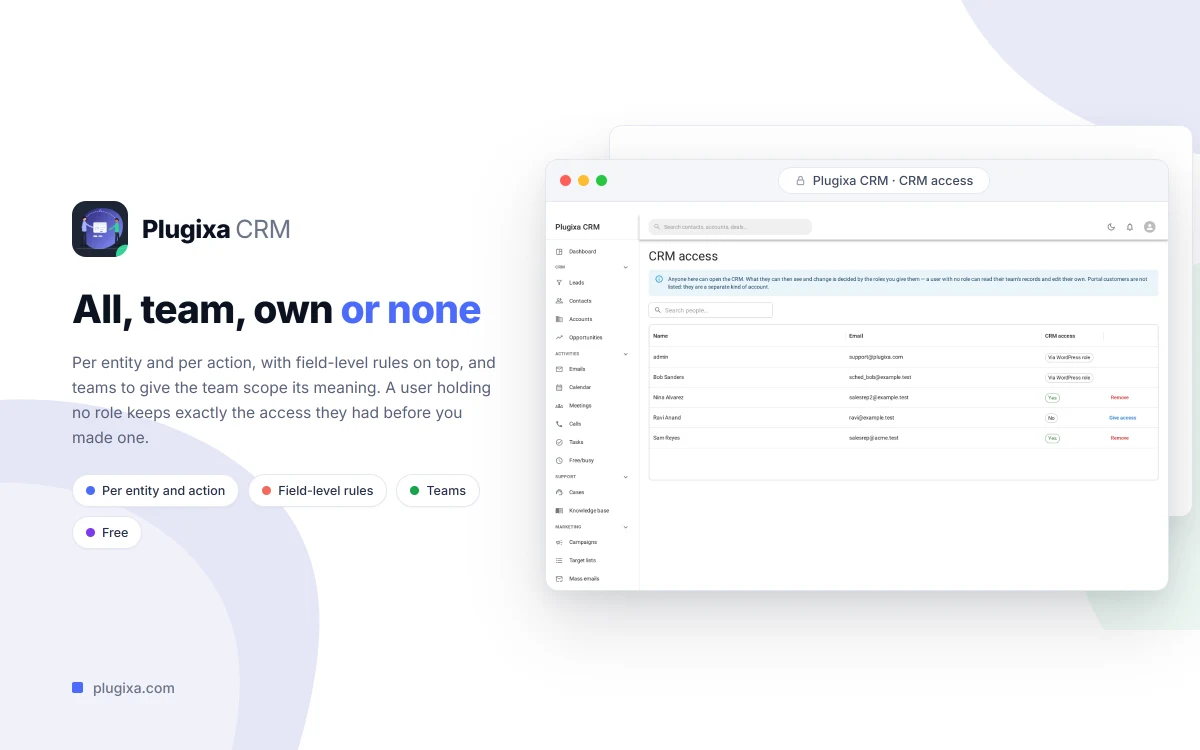
Rules per entity and per action
Read, create, edit, delete and stream, answered separately for each kind of record rather than by one blanket permission.
-
All, team, own or nothing
Scope each action to everything, to the person's team, to what they own, or to none of it. Most permissive wins across roles.
-
Field-level rules
Hide or lock individual fields, so somebody can work a record without seeing the figure on it.
-
Teams
Groups of users, which is what makes the team scope mean something. Membership here, entitlement in the role.
-
Nothing changes until you draw a role
A user holding no role keeps exactly the access they had, so creating the first role is the moment the rules start, not the upgrade.
Staff, customers and the public, on your own site
The same install serves people who work in it, people you serve, and people who have never heard of you.
-
The whole app on a page of your site
One shortcode puts the admin application inside your theme, so staff who should not be in wp-admin never have to go there.
-
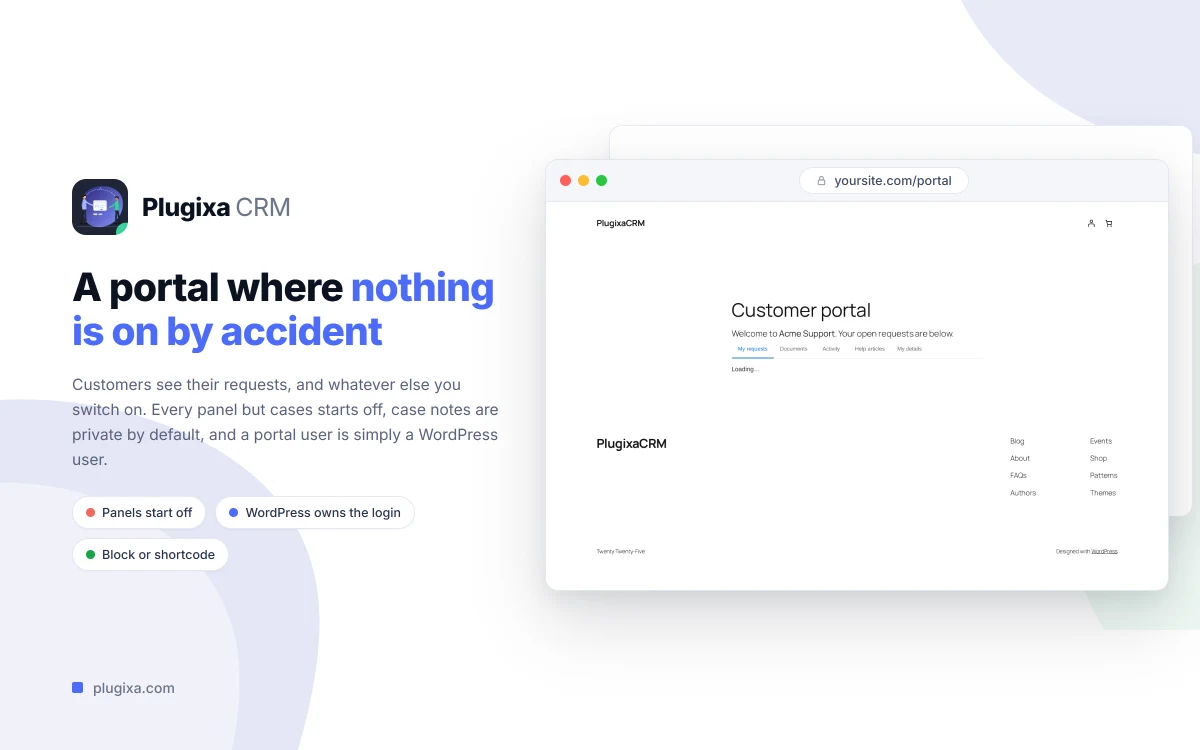
A customer portal
As a block or a shortcode, on a page you choose. Every panel is off until you turn it on, and case notes are private by default.
-
A portal user is a WordPress user
WordPress owns the login, so there is no second password store and no second account for somebody to lose.
-
Web-to-lead forms
A block or a shortcode, with a honeypot, a rate limit, optional CAPTCHA and double opt-in, and a plain form fallback when JavaScript is off.
-
The same rules everywhere
The front end talks to the same API as the admin, so there is no second permission policy to keep in step with the first.
The systems you already run
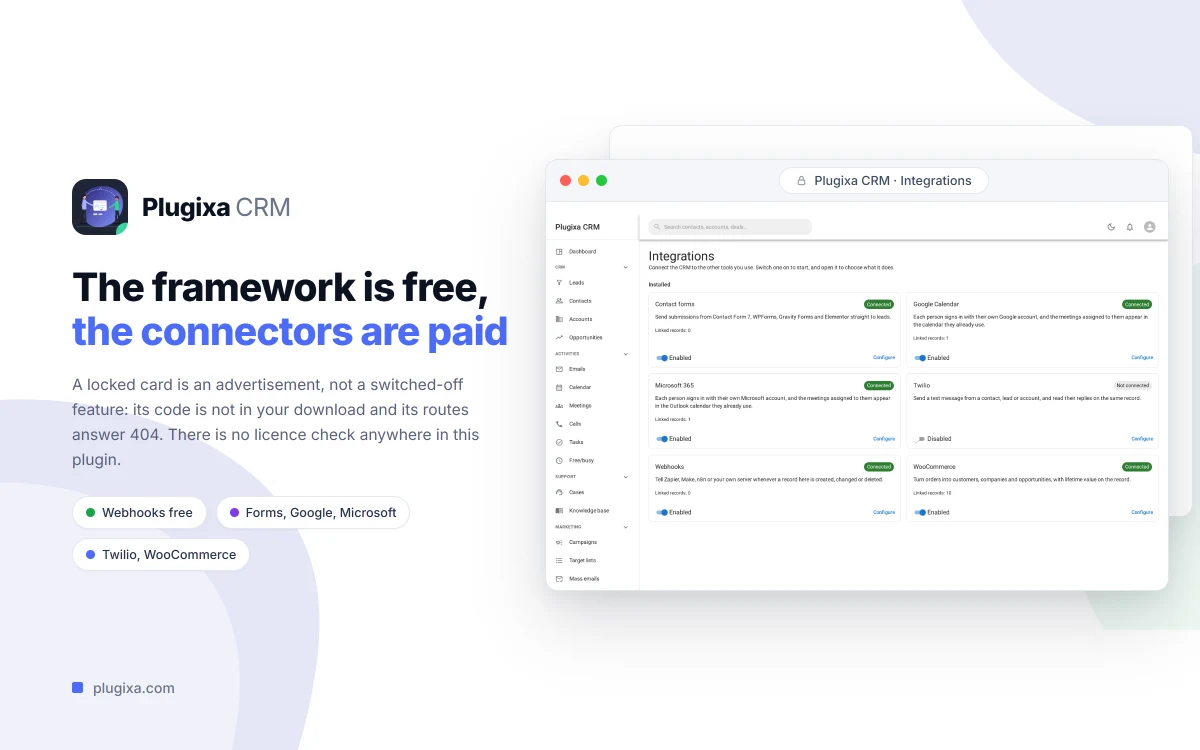
The framework is free and every connector is paid. Nothing is switched off waiting for payment: a connector you have not bought is code that is not there.
-
The framework, free
The connector screen, the encrypted credential store, the job queue and the health checks all ship in the free edition.
-
Outbound webhooks
Tell another system when something changed here, queued and retried, with private and reserved addresses refused on save and again before every request.
-
Contact Form 7, WPForms, Gravity Forms, Elementor Pro
Four adapters behind one card, so the forms already on your site feed the CRM with the mapping set per form.
-
Google Calendar and Microsoft 365 Pro
Calendars for a signed-in person, one account at a time, and a Microsoft mailbox that works for email-to-case without a stored password.
-
Twilio SMS Pro
Text a contact from their record and read the reply on it. It polls rather than taking a webhook, so nothing of yours listens on a public URL.
-
WooCommerce Pro
Your shop as customers rather than as orders: an order becomes a contact on an account, with an order history and a running total.
Simple pricing
Choose your growth plan
Start building with Plugixa CRM today. Upgrade anytime as your needs grow.
Free
Free forever
The whole CRM, not a trial of one
- Accounts, contacts, leads & opportunities
- Pipelines, stages & a kanban board
- Tasks, calls, meetings & one calendar
- Working hours, holidays & free/busy
- Email out, and IMAP in with email-to-case
- Campaigns, target lists & mass email
- Cases & a knowledge base
- Customer portal & public help centre
- Roles, teams & field-level permissions
- Reports, charts & multi-tab dashboards
- PDF templates, CSV and Excel, webhooks
- Community support
Pro
1-Year License
Custom fields, and connectors for the systems you already run
- Everything in Free
- Custom fields on contacts, accounts, leads & deals
- Contact Form 7, WPForms, Gravity Forms & Elementor
- Google Calendar sync
- Microsoft 365 calendars & mailboxes
- Twilio SMS from a record
- WooCommerce customers & order history
- 1 year of updates
- Priority email support
Instant Digital Delivery
Download immediately after checkout
Secure Payment
Encrypted, PCI-compliant checkout
Auto-Updates
One-click updates from WordPress admin
Trusted by Pros
Used on thousands of WordPress sites
FAQ
Frequently asked questions
Getting Started
[plugixa_crm_app] to any page and the whole application appears on it,
inside your theme. It talks to the same API with the same permissions, so there is
no second set of rules to keep in step with the first.Features
List-Unsubscribe header goes
with it, and one unsubscribe stops every campaign rather than just the one the
person happened to be reading.Free vs Pro
Data and Privacy
wp-config.php. That protects them if the database is exposed. It cannot protect
them from somebody who can already read your site’s files, and nothing can.