Contents
Groups — Plugixa Team
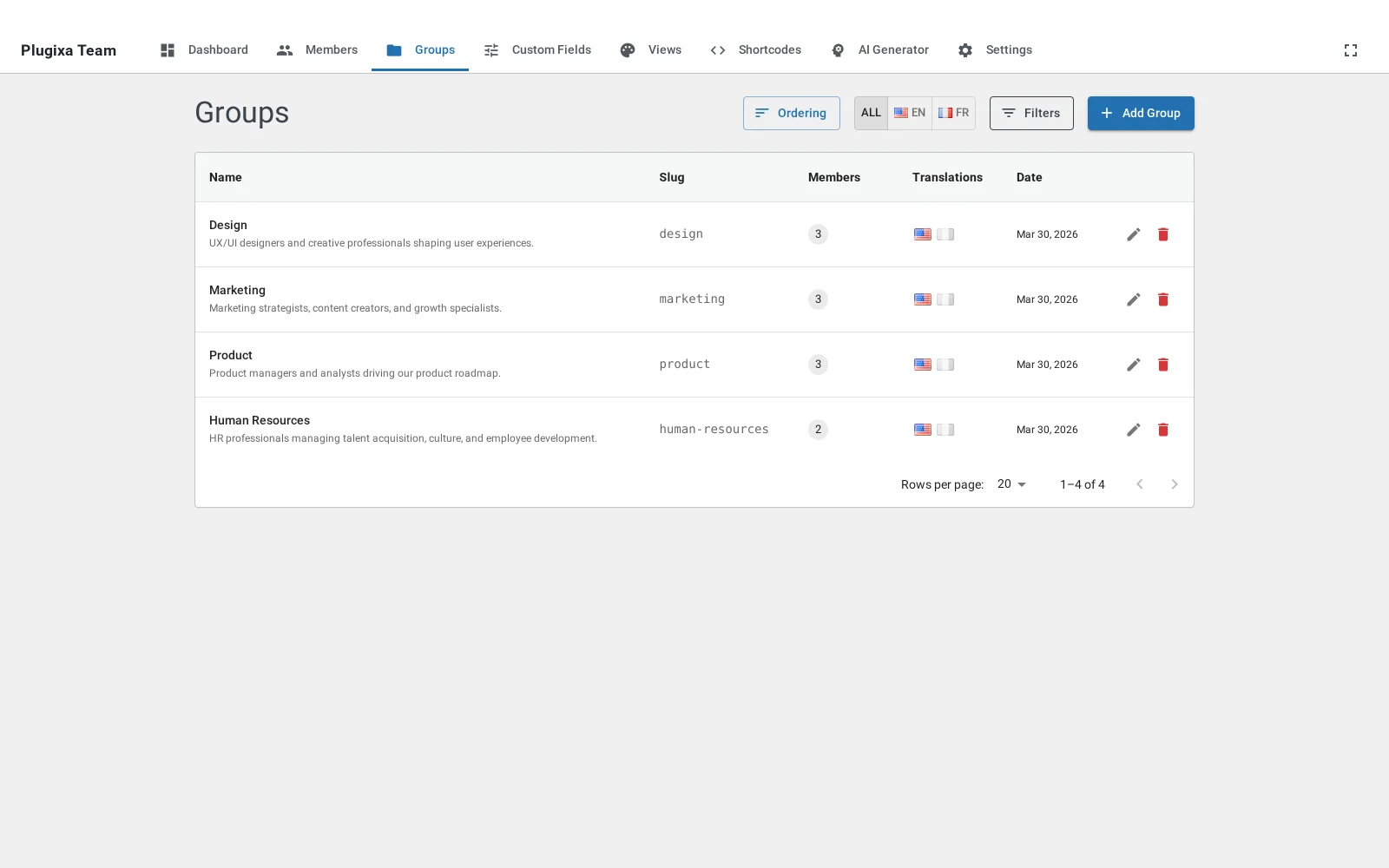
Groups organize team members into departments, teams, committees, or any other category. Members can belong to any number of groups (many-to-many), and each group can have a different member order via the pivot table.
Open Plugixa Team → Groups.

Why groups matter
- Filter shortcodes —
[plugixa_team group="engineering,design"]renders only members in those groups. - Groups navigation — on the frontend, show tabs / pills / dropdown to let visitors filter by group.
- Per-group ordering — a member can appear first in “Leadership” but last in “Engineering”, thanks to the pivot table’s
display_ordercolumn. - Accordion / filter layouts — use groups as the accordion sections or filter buttons.
Create or edit a group

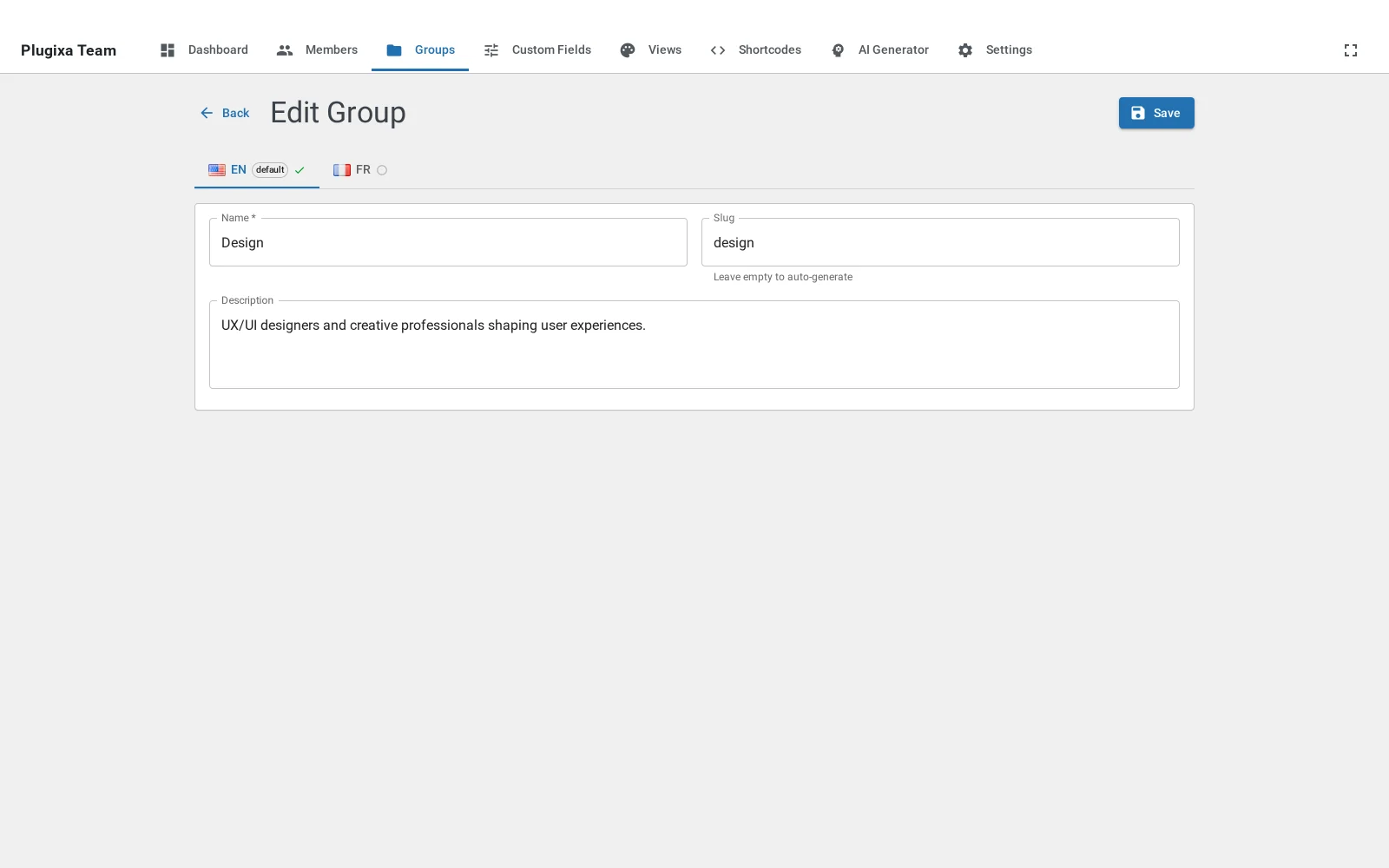
Open a group (or click Add New). The form is simple:
| Field | Notes |
|---|---|
| Name | E.g. “Engineering” or “Leadership”. Required. |
| Slug | Auto-generated; must be unique within a language. Used in shortcode attributes. |
| Description | Optional; displayed under the group header or name when show_description is on. |
| Display order | Controls where the group appears in the groups nav (lower = earlier). |
Translations
When Polylang is active, groups use the batch Translation Tabs pattern. The name, slug, and description are per-language; display_order is shared across translations. See Multilingual.
Reorder groups

Groups → Ordering is a sortable list. Drag to reorder; the order is stored in groups.display_order and determines the sequence in groups-nav displays.
Assign members to a group
Two ways:
- From the member form — the Groups field is a multi-select.
- From the group form — group forms don’t currently include a “members” picker; use the member form instead.
Groups navigation on the frontend

A view can render a Groups Nav bar above the team list. Configure it from Views → {view} → Groups Nav tab:
| Option | Values | Description |
|---|---|---|
enabled |
on / off | Master toggle. |
displayStyle |
tabs, pills, dropdown, sidebar |
Visual style. |
showAll |
on / off | Show an “All” option that clears the filter. |
allLabel |
text | Label for the “All” option (e.g., “Everyone”). |
showMemberCount |
on / off | Show a count badge next to each group. |
showDescription |
on / off | Show the group description when it’s selected. |
colors |
hex | bg / text / activeBg / activeText / border / activeBorder. |
typography |
px | Font size + weight. |
spacing |
px | gap, padding, margin. |
border |
px | Width + radius. |
Shortcode overrides
[plugixa_team groups_nav="yes" show_member_count="yes"]
groups_nav="yes"forces the nav on even if the view has it disabled.groups_nav="no"forces it off.show_member_count="yes"shows the per-group count badge.
Filter by group in a shortcode
[plugixa_team group="engineering"] # single slug
[plugixa_team group="3,8,12"] # comma-separated IDs
[plugixa_team group="engineering,design"] # comma-separated slugs
Slugs are resolved to IDs automatically. When multilingual, slugs are matched via the group’s translation group, so localized slugs still work.
Use groups in layouts
Some layouts use group membership internally:
- Filter layout — renders a button bar of all groups; click to filter client-side. Every group with at least one member becomes a button.
- Accordion layout — groups become the accordion sections when combined with groups nav.
- Org chart — not group-based; uses
parent_idinstead.
For other layouts (grid, list, masonry, carousel, table, inline), groups are purely a filter — the layout itself doesn’t change based on groups.
Member count per group
The /groups REST endpoint returns a member_count field computed via a pivot join against member_groups. This count respects translation grouping (counts distinct translation_group values so one multilingual member doesn’t count twice).
REST API
GET /wp-json/plugixateam/v1/groups
POST /wp-json/plugixateam/v1/groups
GET /wp-json/plugixateam/v1/groups/{id}
PUT /wp-json/plugixateam/v1/groups/{id}
DELETE /wp-json/plugixateam/v1/groups/{id}
POST /wp-json/plugixateam/v1/groups/reorder
Troubleshooting
The groups nav doesn’t appear
- Confirm the view has Groups Nav → Enabled turned on, OR pass
groups_nav="yes"in the shortcode. - The nav is hidden when there’s only a single group (or zero) — add at least two published groups with members.
A translated group is missing from the nav
- Confirm the translated group has the same
translation_groupUUID as the source. - Confirm the group’s translated status is published (there’s no separate “published” field — but empty names fall back to the default language).
Member count is wrong
The count filters for published members only. Draft and hidden members don’t contribute.
Related
- Members Management
- Views — groups nav configuration
- Shortcodes —
group/groups_nav/show_member_countattributes - Multilingual