Contents

AI Team Generator — Plugixa Team

Generate team members automatically from a topic, a URL, or an uploaded document (PDF / DOCX / TXT). Uses OpenAI or Google Gemini behind the scenes.

Perfect for:

  • Bootstrapping a demo team for a client site.
  • Extracting real team data from an existing staff page.
  • Turning a PDF company directory into structured member profiles.

Setup

1 · Get an API key

Pick a provider:

2 · Configure the plugin

Go to Plugixa Team → Settings → AI.

AI provider settings

Field Notes
Enable AI Generator Master toggle.
Provider openai or google.
API key Encrypted at rest. Never displayed after save.
Model See Models.
Temperature 0.0 (deterministic) to 1.0 (creative). 0.7 is a good default.
Max tokens Response length cap. 2000 is typical, up to 8000 for large batches.
Default language Target language for generated content (e.g., “English”, “French”).

3 · Test the connection

Generation settings detail

Click Test connection. The plugin makes a minimal request and reports success, API error, or rate-limit.

The generator UI

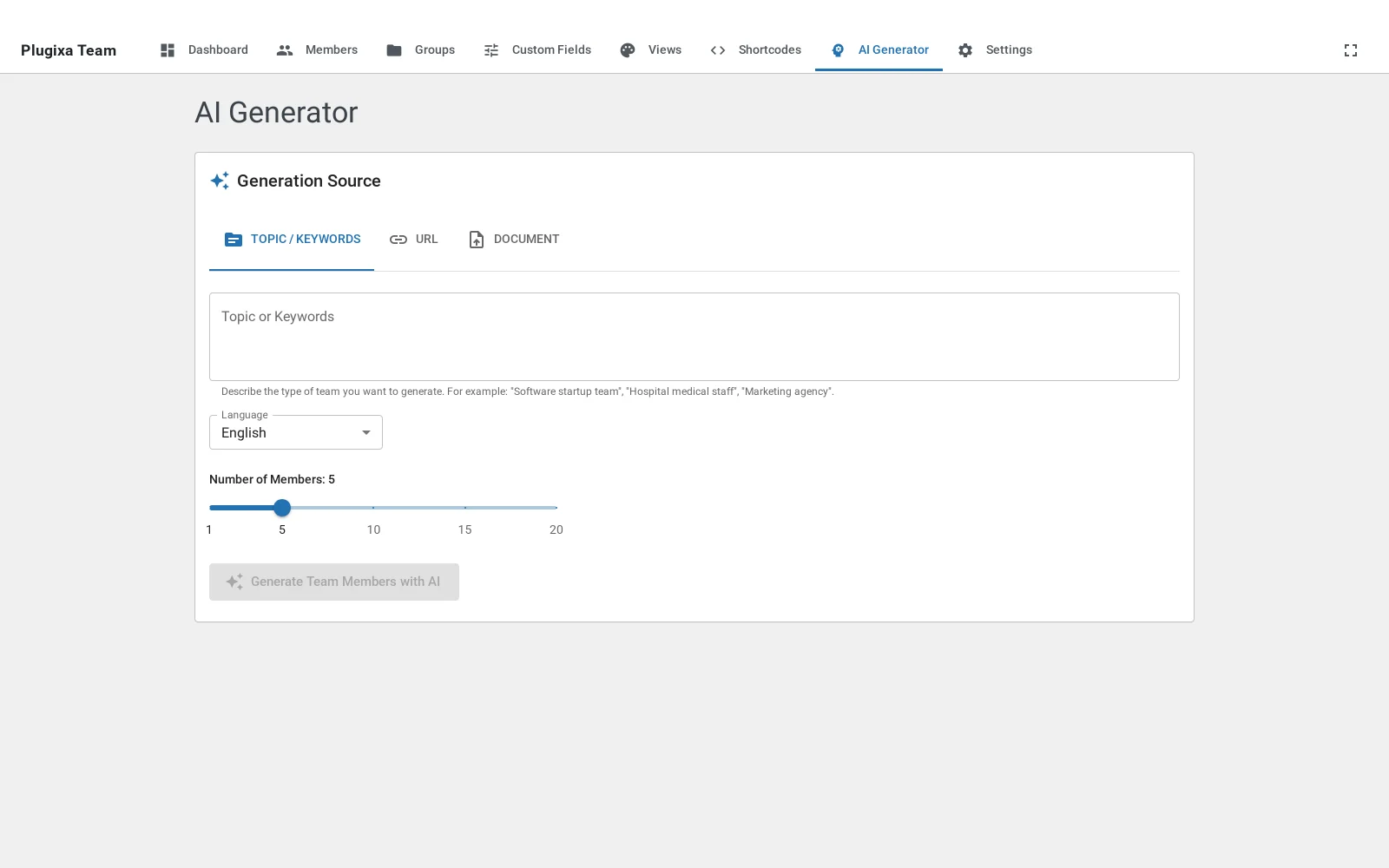
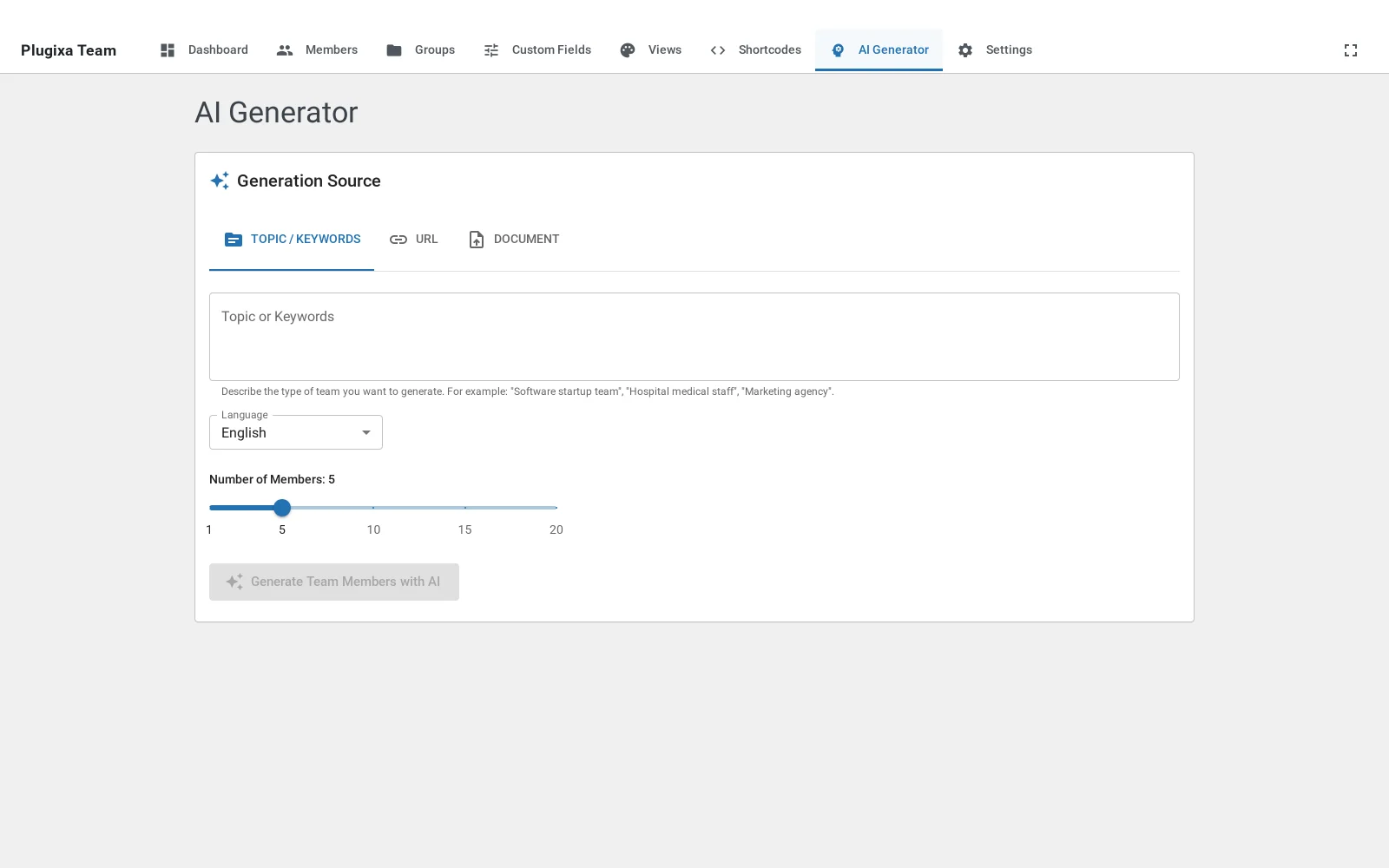
Open Plugixa Team → AI Generator to run a generation. Pick a provider, a source (topic, URL, or uploaded document), and the target language, then click Generate to preview and accept members before they’re saved.

AI Generator

Models

OpenAI

Model Cost Speed Quality Recommended use
gpt-4o-mini $ Fast Good Default — bulk generation
gpt-4o $$ Fast Excellent Flagship content
gpt-4-turbo $$ Medium Excellent Legacy — prefer 4o
gpt-3.5-turbo $ Fast OK Budget draft

Models are fetched dynamically from OpenAI via the Reload Models button, so new releases appear automatically.

Google Gemini

Model Cost Speed Quality Notes
gemini-2.0-flash $ Fast Good Default
gemini-1.5-pro $$ Medium Excellent Long-context — good for big documents
gemini-1.5-flash $ Fast Good Legacy flash

Three ways to generate

Open Plugixa Team → AI Generator. Pick a source tab:

From a topic

Enter a topic and a count, then click Generate. The AI produces N fictional member profiles with varied cultural backgrounds (randomized by the prompt to avoid stereotypes) and realistic job titles.

Topic: "Software engineering team for a fintech startup"
Count: 8
Language: English

Output per member:

  • first_name, last_name
  • job_title (role-appropriate)
  • department
  • bio (~3–4 sentences)
  • short_bio (~1 sentence)
  • skills (array of { name, percentage, color })
  • social_links (realistic platform mix)

Best for: Placeholder teams during design/demo work.

From a URL

Paste a URL (e.g. an existing “About us” / “Our team” page). The plugin:

  1. Fetches the page via class-url-scraper.php (15,000 char content limit).
  2. Strips HTML and boilerplate, extracting main content.
  3. Sends the content to the AI with a specialized prompt that asks for real names and jobs extracted from the source (not fictional generation).

Best for: Migrating from a WordPress team plugin that doesn’t have export, or seeding from a public staff page.

From a PDF or document

Upload a PDF, DOCX, or TXT file (max 5 MB). The plugin:

  1. Parses text via smalot/pdfparser (PDF), PhpWord (DOCX), or encoding-aware decoder (TXT).
  2. Sends the extracted text to the AI.
  3. Returns structured member records.

Common use: Turn a company’s internal staff directory PDF into structured WordPress members.

Group generation

From the Groups tab of the generator, generate group names and descriptions from a prompt like “departments for a marketing agency”. The AI returns a list of groups, which you can then import — handy when seeding a fresh site.

Review and import

After generation, members appear in a preview table:

  • Regenerate a single row — click the regenerate icon to rewrite that row only.
  • Inline edit — click any field to edit inline.
  • Reject — remove a row from the batch.
  • Group assignment — pick an existing group or generate new ones for the batch.

Click Import. The plugin saves the remaining rows as draft members with source = 'ai-generated'. You can then review and publish them normally.

Multilingual generation

If Multilingual is active, the Target language field lets you generate directly in any supported language. The imported members are tagged with the corresponding language_code and each gets its own translation_group.

REST API

All endpoints require the manage_options capability + valid Pro license.

POST /wp-json/plugixateam/v1/ai-generator/generate/topic
POST /wp-json/plugixateam/v1/ai-generator/generate/url
POST /wp-json/plugixateam/v1/ai-generator/generate/file
POST /wp-json/plugixateam/v1/ai-generator/generate/groups
POST /wp-json/plugixateam/v1/ai-generator/import
POST /wp-json/plugixateam/v1/ai-generator/test-connection
POST /wp-json/plugixateam/v1/ai-generator/load-models
GET  /wp-json/plugixateam/v1/ai-generator/models

Example — generate 5 members from a topic:

POST /wp-json/plugixateam/v1/ai-generator/generate/topic
Content-Type: application/json
X-WP-Nonce: <nonce>

{
  "topic": "DevOps team for a SaaS platform",
  "count": 5,
  "language": "English"
}

Response:

{
  "success": true,
  "members": [
    {
      "first_name": "Priya",
      "last_name": "Raman",
      "job_title": "Senior SRE",
      "department": "Infrastructure",
      "bio": "…",
      "skills": [ { "name": "Kubernetes", "percentage": 90, "color": "#326ce5" } ],
      "social_links": [ { "platform": "linkedin", "url": "https://linkedin.com/..." } ]
    },
    …
  ]
}

Cost estimation

Rough costs per batch of 10 members with gpt-4o-mini at default settings:

  • ~3,000 input tokens (prompt + instructions)
  • ~5,000 output tokens (10 full profiles)
  • Cost: ~$0.005 USD

URL and document flows add input tokens proportional to the source length. A 20-page PDF adds ~10,000 input tokens.

Composer dependencies (installed with the plugin)

  • theodo-group/llphant ^0.7 — OpenAI PHP client
  • smalot/pdfparser ^2.0 — PDF text extraction
  • mpdf/mpdf ^8.0 — PDF export (used by Import/Export, not the generator)
  • PhpWord (transitive via LLPhant) — DOCX parsing

All ship bundled in the Pro build — you don’t need to install anything manually.

Troubleshooting

“API error 401”

API key is wrong or revoked. Regenerate in the provider dashboard and re-save in Settings → AI.

“API error 429”

Rate-limited by the provider. Wait, or switch to a higher-tier plan. For OpenAI, the first $5 of usage on a new key often hits low rate limits.

Generated members look generic

  • Raise specificity — “Engineering team” → “Engineering team for a ML platform startup, Python/Go heavy, remote-first culture”.
  • Lower temperature to 0.5 for more consistency; raise to 0.9 for more variation.
  • Provide context — many prompts accept a context paragraph you can paste in.

URL scraping returned nothing

Some sites block scrapers with bot detection, JavaScript-rendered content, or 403 responses. Workarounds:

  • Save the page as PDF from your browser and upload that instead.
  • Copy the visible content into a TXT file and upload.
  • Paste the extracted text into the topic field directly.

PDF parsing fails

  • Check the PDF is text-based, not scanned images. Scanned PDFs need OCR first (not included).
  • Check file size — 5 MB max.
  • Password-protected PDFs aren’t supported.

Quick Links