

Contents
Question types - Plugixa Exam
Fourteen question types: seven in the free edition, seven more with Pro. Twelve of them mark themselves. Only essay and file upload need a person.
The full list
| Type | Edition | Marked | What it asks |
|---|---|---|---|
| Multiple choice, single answer | Free | Automatically | One option from several |
| Multiple choice, several answers | Free | Automatically | Any number of options |
| True / false | Free | Automatically | One of two |
| Short answer | Free | Automatically | A typed word, phrase or number |
| Essay | Free | By a person | Long-form writing, against a rubric |
| Fill in the blanks | Free | Automatically | A passage with gaps |
| Picture choice | Free | Automatically | One image from several |
| Ordering | Pro | Automatically | Items in the right sequence |
| Matching | Pro | Automatically | Pairs from two lists |
| Extended matching | Pro | Automatically | Several stems, one shared option list |
| Hotspot | Pro | Automatically | A point or area marked on a picture |
| Image matching | Pro | Automatically | Pairs of images |
| Range | Pro | Automatically | A number inside a band |
| File upload | Pro | By a person | Coursework, a portfolio, a spreadsheet |
The free seven
Multiple choice
Two separate types: one where exactly one option is correct, and one where any number can be. The second is where partial credit usually earns its keep, and where you may want negative marking so that selecting everything is not a strategy. See Grading.
Options can be shuffled independently of the questions around them.
True / false
The simplest type, and the one with the most notorious marking bug in the
category. A blank answer here scores zero, checked before any type-specific
marking runs. false, 0 and "0" are treated as real answers, because a
correct answer of “False” must not be mistaken for an empty one.
Short answer
A typed response, matched in one of three ways:
| Mode | Behaviour |
|---|---|
| Text | Case-insensitive comparison against a list of accepted answers |
| Numeric | Compared as a number, within a tolerance you set |
| Regular expression | Matched against a pattern |
Give as many accepted answers as the question deserves. An invalid regular expression is rejected rather than silently matching nothing.
Essay
The one free type a person marks. Attach a rubric, which the grader sees beside the answer. Until an essay is marked, the candidate’s review of the whole paper stays locked, because a partial score would disclose the rest.
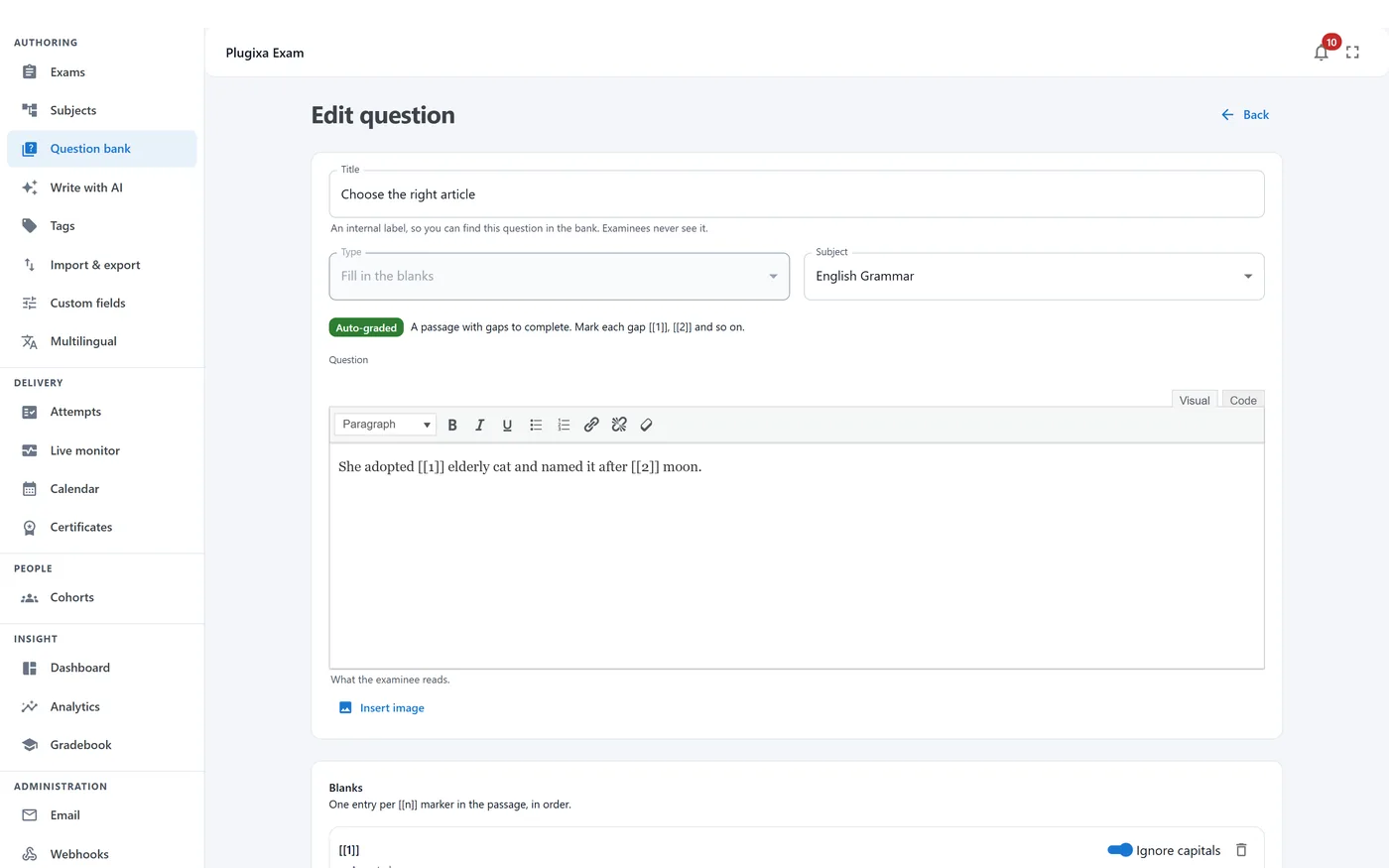
Fill in the blanks
A passage with gaps, where each blank carries its own list of accepted answers. Blanks are marked independently, so partial credit follows naturally from getting three of four right.
Picture choice
The options are images rather than text. Each option asks for a description for people who cannot see it, and a site can make that description required.
Uploads are limited to PNG, JPG, GIF and WebP, and are checked by decoding the file rather than trusting its name or the type the browser claimed. A site that allows SVG uploads elsewhere still cannot put one in an exam. See Images in Questions.
Without JavaScript, a picture question falls back to a labelled list, so it stays answerable.
The Pro seven
| Type | Notes |
|---|---|
| Ordering | Drag items into sequence. Partial credit by position. |
| Matching | Pair items from two lists. Partial credit per pair. |
| Extended matching | Several stems answered from one shared option list, the standard format in medical and professional exams. |
| Hotspot | Mark a point, or drag out an area, on a picture. Graded on where they marked. Falls back to a labelled grid without JavaScript. |
| Image matching | Matching, but both sides are images. |
| Range | An answer is correct if it falls inside a band, for questions where “about 4.2” is the right answer. |
| File upload | Candidates hand in a file. Marked by a person. Files are kept out of the media library, in a private directory with an unguessable name and a deny rule, served only through a route that checks who is asking. |
What happens when a type is not installed
Every type is contributed through a single filter, and nothing anywhere branches on “is this premium”. That has a consequence worth relying on:
Downgrading never breaks a question you have already written. A question whose type is no longer installed still renders, still exports, and is still marked using the answer key it already has. What the gate blocks is creating a new one.
The same principle covers an unknown type defensively. If the plugin does not recognise a type at marking time, the response is left for a person rather than scored zero, so a missing module cannot silently fail a whole cohort.
Choosing types
- If you want the exam marked the moment it is handed in, avoid essay and file upload. Everything else scores itself.
- If you want a defensible mark rather than a fast one, essay plus a rubric is what you are looking for.
- Picture choice and hotspot are the two types most likely to be affected by a candidate’s device. Both have a no-JavaScript fallback, but test them on a phone before an exam that matters.
What to do next
- Write your first questions in Questions.
- Understand exactly how each answer becomes a number in Grading.
- Bring in questions you already have with Import and Export.