

Contents
Sections and pools - Plugixa Exam
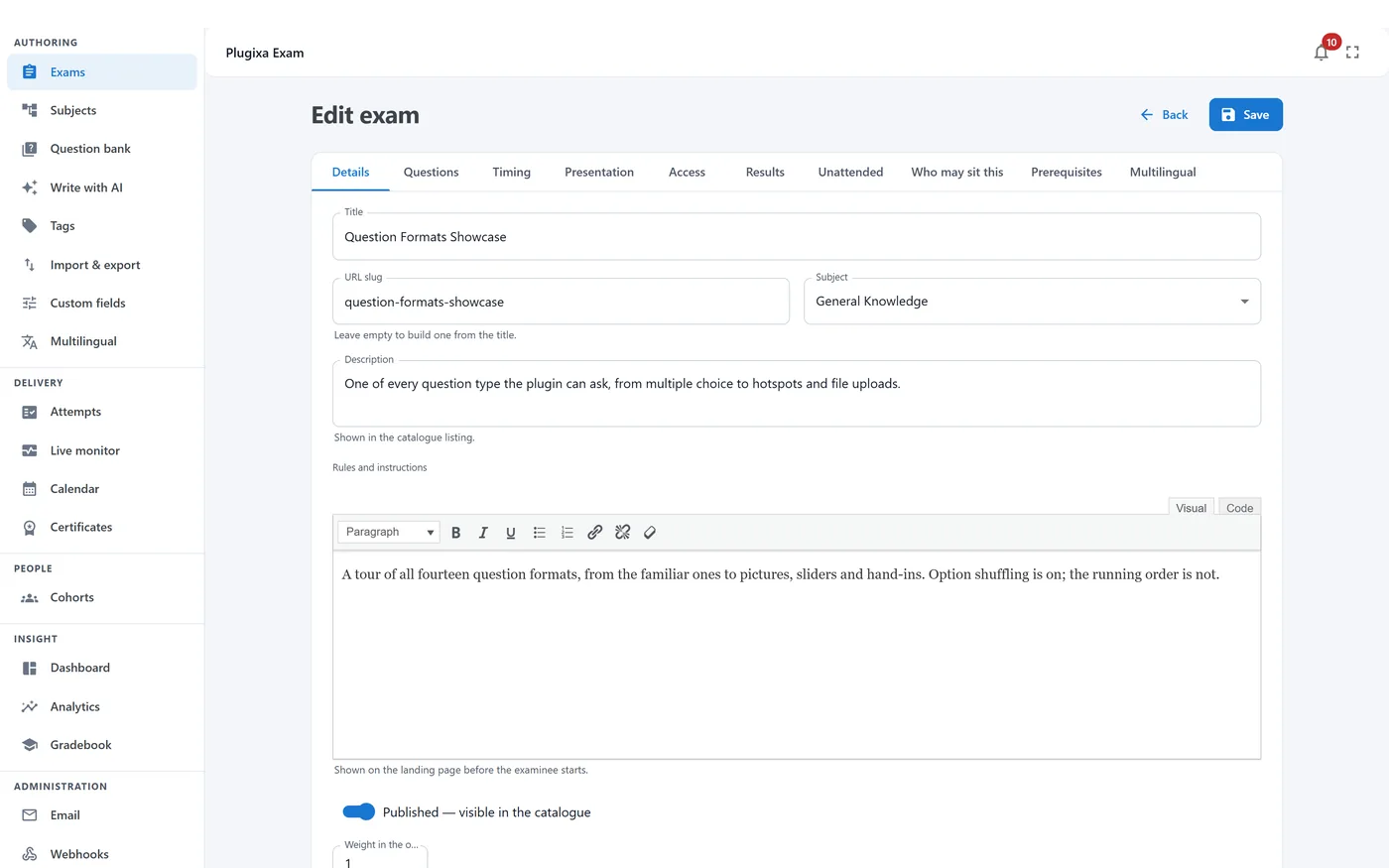
An exam is not a list of questions. It is a list of sections, and each section decides for itself whether every candidate sees the same thing.
The two kinds of section
A fixed list
You pick the questions and set their order. Everybody sees the same ones.
Use it for the questions everybody must answer, for a section that has to run in a particular sequence, or for any exam where candidates will compare papers afterwards.
A pool
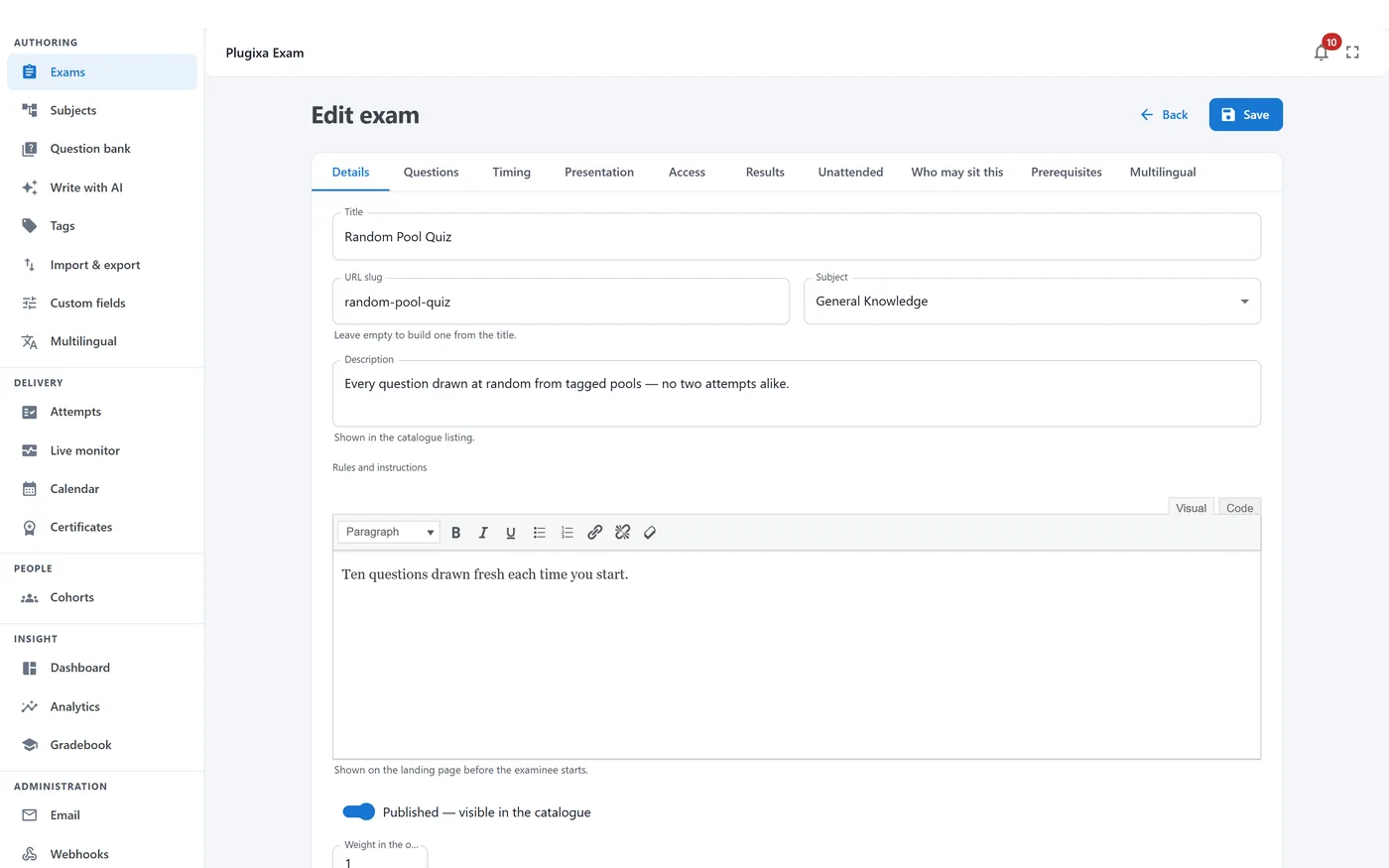
You describe what you want and let each attempt draw its own:
| Rule | What it filters on |
|---|---|
| Subject | A node in the subject tree |
| Tag | Any free-form tag on the question |
| Difficulty | The question’s difficulty |
| Type | Multiple choice, essay, and so on |
| How many | The number of questions to draw |
So a section can say “three questions from Algebra, tagged 2026, medium difficulty”, and the bank supplies a different three to each candidate.
A single exam can mix both: a fixed section for the compulsory questions and a pool for the rest.
When a pool draws
When the attempt starts, once. The draw is then frozen into that attempt.
Two consequences worth relying on:
- A candidate who reloads gets the same paper, not a new one. Refreshing is not a way to fish for easier questions.
- Editing the exam, or the pool’s rules, while somebody is mid-paper changes nothing for them. See Exam Runner.
A pool needs enough questions to draw from. If a pool asks for five questions and the rules only match three, the paper is short. Widen the rules, or write more questions before you rely on the pool.
Shuffling
Two independent switches per exam:
| Switch | Effect |
|---|---|
| Shuffle questions | The order of the questions changes |
| Shuffle options | The order of the options inside each question changes |
They are independent on purpose. Shuffling options alone defeats “the answer is always B” without changing the order a paper reads in, which matters when the questions build on each other.
The shuffle is seeded per attempt, so it is stable across reloads for that candidate and different between candidates.
Points
A question’s value resolves in this order:
- The points set on that question in this exam.
- The pool’s points-per-question.
- The question’s own default points from the bank.
That is why a pool can be worth a flat two marks a question without you editing every question it might draw.
Ordering
Sections run in the order you arrange them, and within a fixed section the questions run in the order you set, unless shuffle questions is on.
A question can legitimately appear twice in one exam if it is in two different sections, for example once in a warm-up and once in a review. Twice in the same section is always a mistake, and is prevented.
Designing a pool that is fair
Random papers are only fair if the pool is homogeneous. Some practical rules:
- Pool within one subject and one difficulty, not across several. A pool spanning “Algebra” and “Calculus” hands some candidates a harder paper.
- Use tags for the cross-cutting axis. Subject for what it is about, difficulty for how hard, tags for anything else (syllabus year, exam board, source).
- Mind the points. Set points-per-question on the pool so every draw is worth the same, whatever the bank’s defaults happen to be.
- Check the pool size. A pool of six drawing five is barely random and one deletion away from being short.
Troubleshooting
| Symptom | Usual cause |
|---|---|
| Everybody got the same “random” paper | The section is a fixed list, or the pool’s rules match exactly as many questions as it draws. |
| A paper came out short | The pool’s rules match fewer questions than it asks for. |
| Total marks differ between candidates | The pool has no points-per-question, so each drawn question is using its own default from the bank. |
| A question appeared twice | It is in two sections. That is allowed; move or remove one. |
| Edits to a pool are not showing | Attempts already in progress hold their own frozen draw. The change applies to the next person who starts. |
What to do next
- See what the candidate experiences in Exam Runner.
- Tune the bank the pools draw from in Subjects and Tags.
- Set the value of each answer in Grading.