

Contents
Subjects - Plugixa Exam
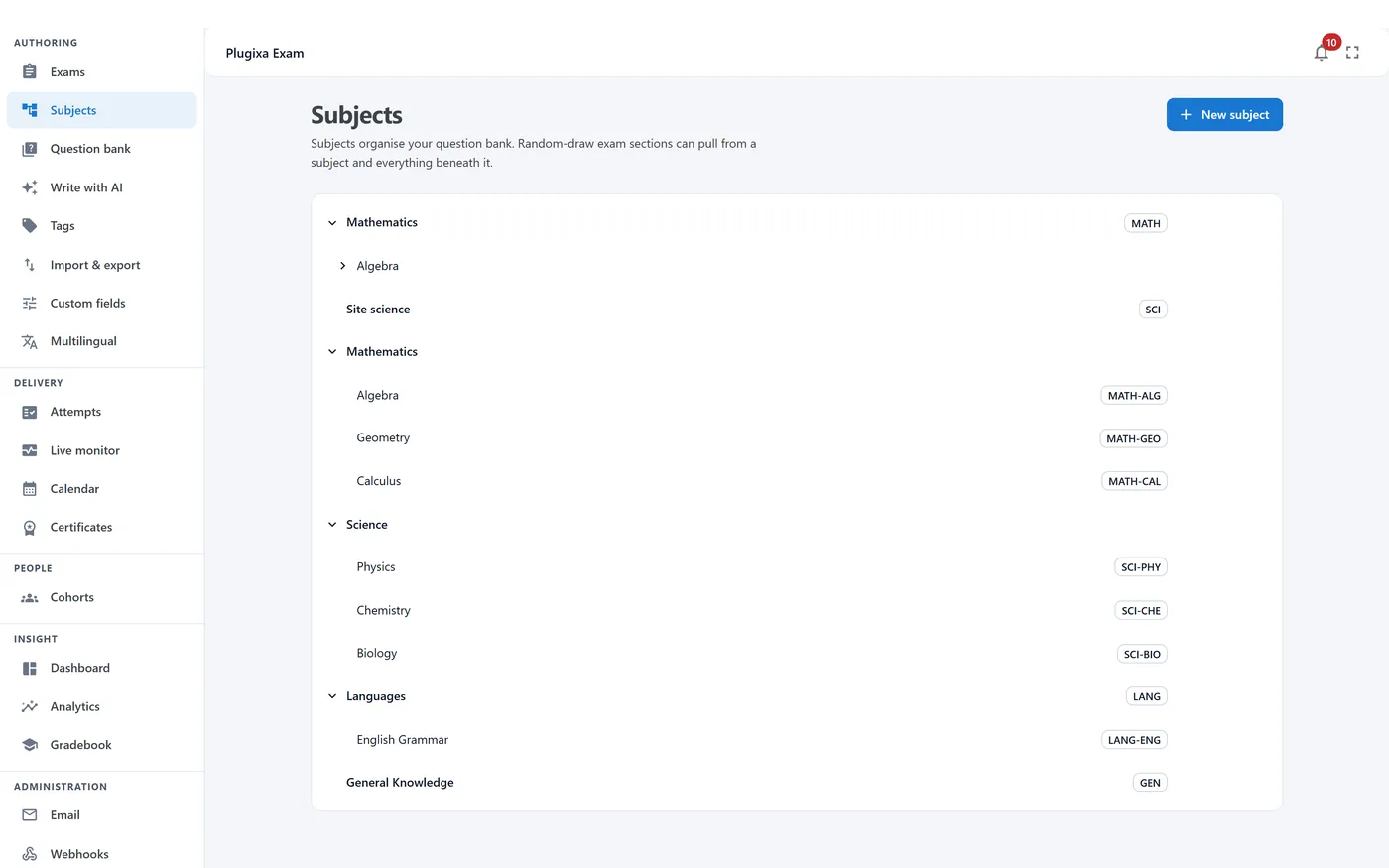
A subject is a node in a tree. Every question belongs to one, and that single fact does more work than it looks like it should.
Why subjects are not just filing
Two things depend on them:
- Results break down by subject. A candidate who scored 62% gets a report that says which subjects carried them and which did not. That is the difference between a mark and something a learner can act on.
- Pools select on them. A section can say “three questions from Algebra” and draw a different three for every candidate. See Sections and Pools.
Building the tree
Go to Exams -> Subjects. Add a top-level subject, then add children under it. Nest as deep as your syllabus goes.
Mathematics
  Algebra
    Linear equations
    Quadratics
  Geometry
Science
  Physics
  Chemistry
Each subject shows how many questions sit under it, so you can see at a glance where the bank is thin before an exam finds out for you.
How deep to go
Deep enough that a pool rule is useful, and no deeper.
- Too flat and a pool drawing from “Mathematics” hands one candidate three algebra questions and another three geometry ones. Those are different papers.
- Too deep and every leaf holds two questions, so a pool cannot draw without either repeating or reaching into a sibling.
A practical test: a subject is the right size when you would be comfortable saying “any three questions from here are equivalent”.
Subjects and difficulty are different axes
Do not encode difficulty into the tree. There is a difficulty field on the question for that, and a pool can filter on both at once: “two hard questions from Quadratics”.
The same applies to anything else cross-cutting. Syllabus year, exam board, the source a question came from - those are Tags.
Moving and deleting
Moving a subject takes its questions with it, and the tree repairs its own paths. Existing attempts are unaffected: a paper already sat holds its own frozen copy of what it asked.
Deleting a subject that still has questions is the one to think about. Move the questions first, or you will be looking for them later.
Troubleshooting
| Symptom | Usual cause |
|---|---|
| A pool comes up short | The subject holds fewer questions than the pool draws. The count beside each subject is the quickest check. |
| Results show no subject breakdown | The questions on that exam all sit under one subject, so there is nothing to break down. |
| A subject shows zero questions but is not empty | The questions are under its children, not on it directly. Counts are per node. |
| Two candidates got very different papers from one pool | The pool is drawing across a subject that spans more than one topic. Narrow it, or split the subject. |
What to do next
- Add the cross-cutting axis with Tags.
- Fill the bank in Questions.
- Draw from it in Sections and Pools.